Friday, April 28, 2006

A little tour of the farm

I finally got a hold of a camera, so I took some pictures of the farm and Aguabuena, so hold on to your hats, and we´ll take a little walk around.

WELCOME TO AGUABUENA


Aguabuena and Coopabuena are a ten minute walk away from each other seperated by the Rio Salto. This hill (which is a mountain if you look at it from the ocean on the other side) rises above Coopabuena to an altitude of over 4000 feet. Santa Cecilia and Santa Teresa are two villages higher up the mountain, Santa Teresa being at the top.
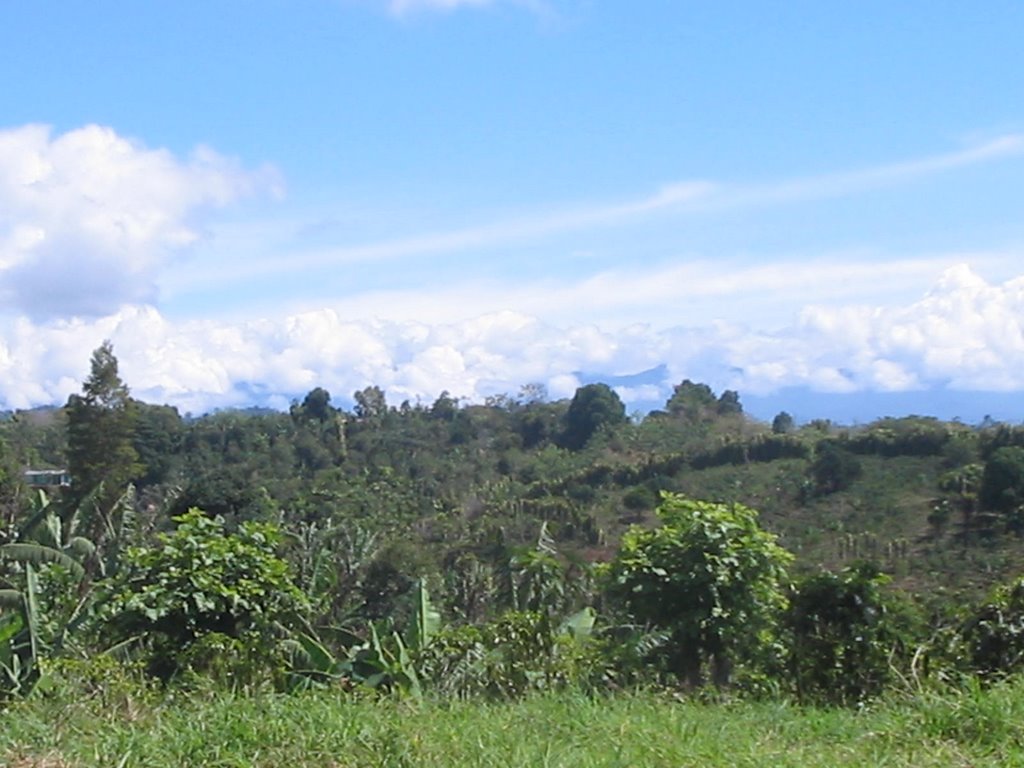


To the north and east of here are the volcanic Talamanca mountains that you can barely make out behind the clouds. These mountains are much higher, rising from 7-1200 ft. This is the home of the nearly inpenetrable cloud forests of Parque Amistad shared by both Panama and Costa Rica. The mountains in this picture are in Panama.

Now to our farm.
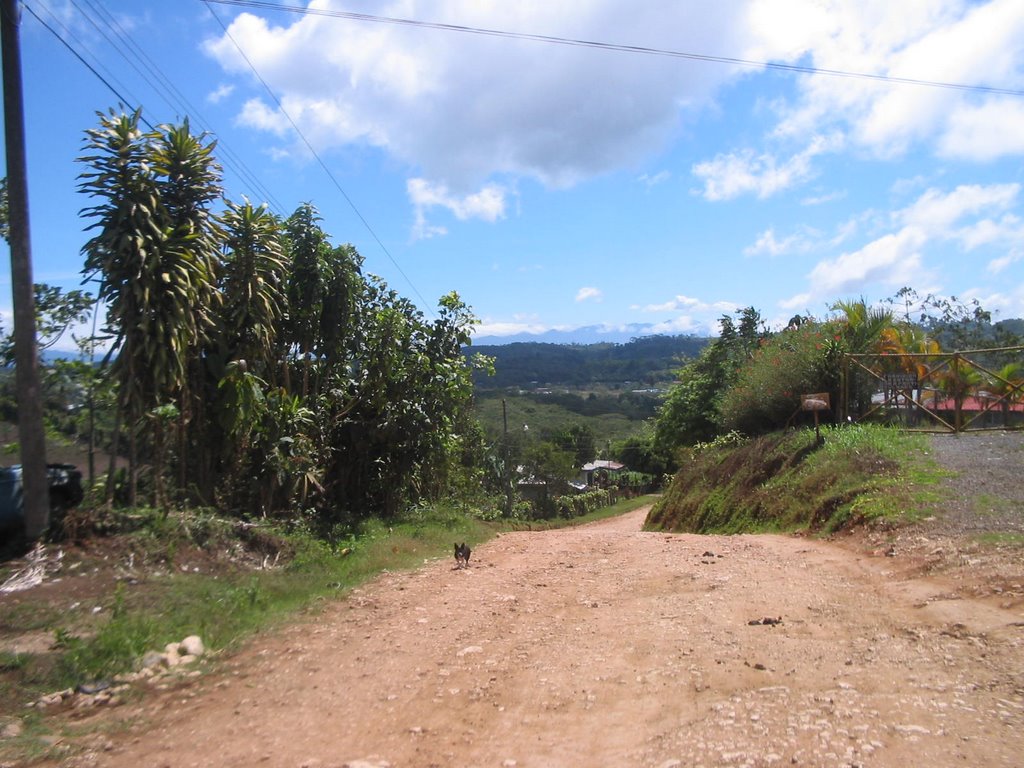


If you follow this road down long enough you will make it to our farm.


The Reforestation Nursery (still under progress)
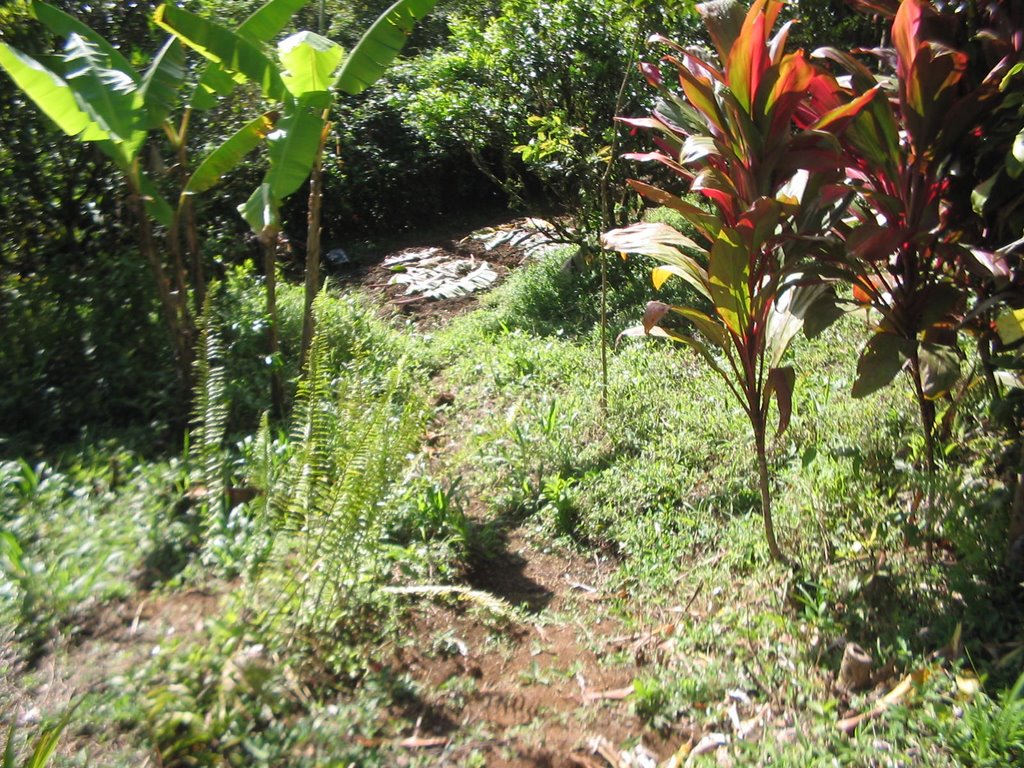


This week I began the germination of our first seeds. I planted over 6000 seeds. The two seed beds down in the background are the beginnings of our seedling nursery. These two beds contain two different species of trees.

1. maria
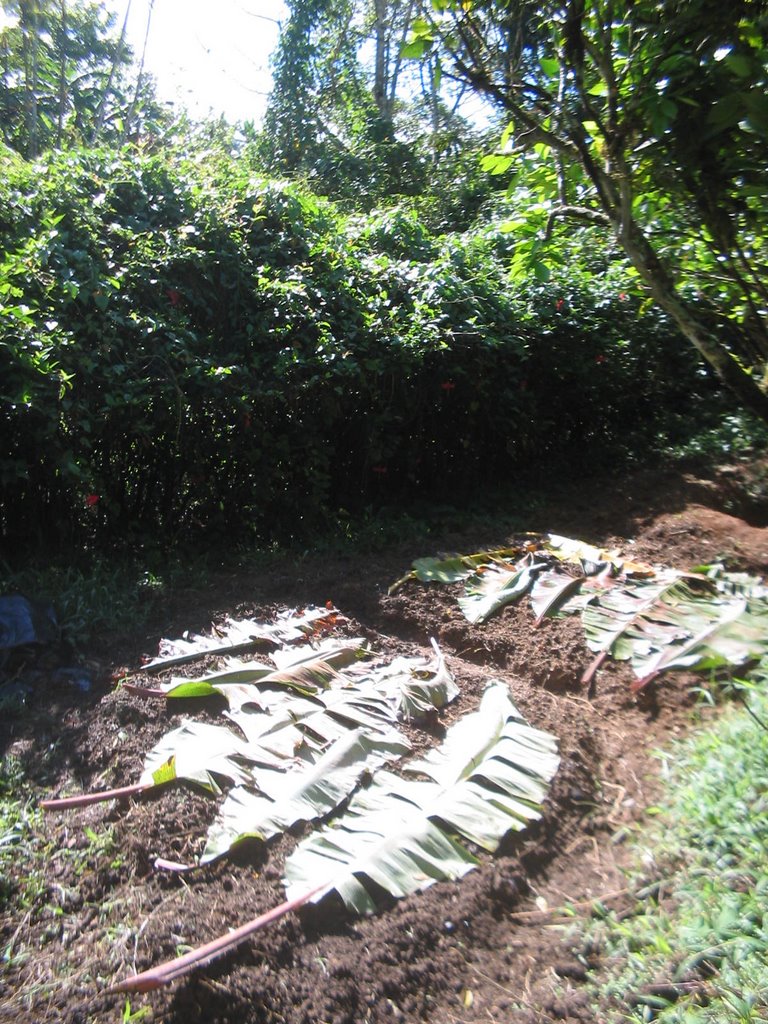
Marias are a common canopy tree of this region. The wood is of medium hardness and considered very valuable for furniture making among other things. Because of this, many have been cut down in this region. These trees grow relatively fast. In this seedbed, I planted 1200 seeds. I cover them with banana leaves to protect the seedlings from excessive sun and as an attempt to stop too many weeds from growing.


2. nogal

Nogales are a Nicaraguan black walnut. They are not indeginous to this part of Costa Rica. They grow very fast. They are becoming increasingly popular among the campesinos here because the grow so fast. Since we our goal is to use only indeginous trees for our reforestation projects, we have some reservations about this tree, so I am only germinating 300 seeds. These are in the bed next to the marias.


3. danto

Dantos are an endangered tropical hardwood. The wood is extremely hard and is excellent wood for construction because of its extreme durablitiy although it is difficult to cut through. Many people in this region dont know of these trees, or have forgotten about them because of their scarcity. These trees prefer to grow above 1000 meters in riverbeds. Thus, they make a nearly perfect tree for our project. The only drawback of this tree is that it grows very slowly because the wood is so dense. In this picture I have 4-5000 seeds soaking in water before I plant them in the ground.
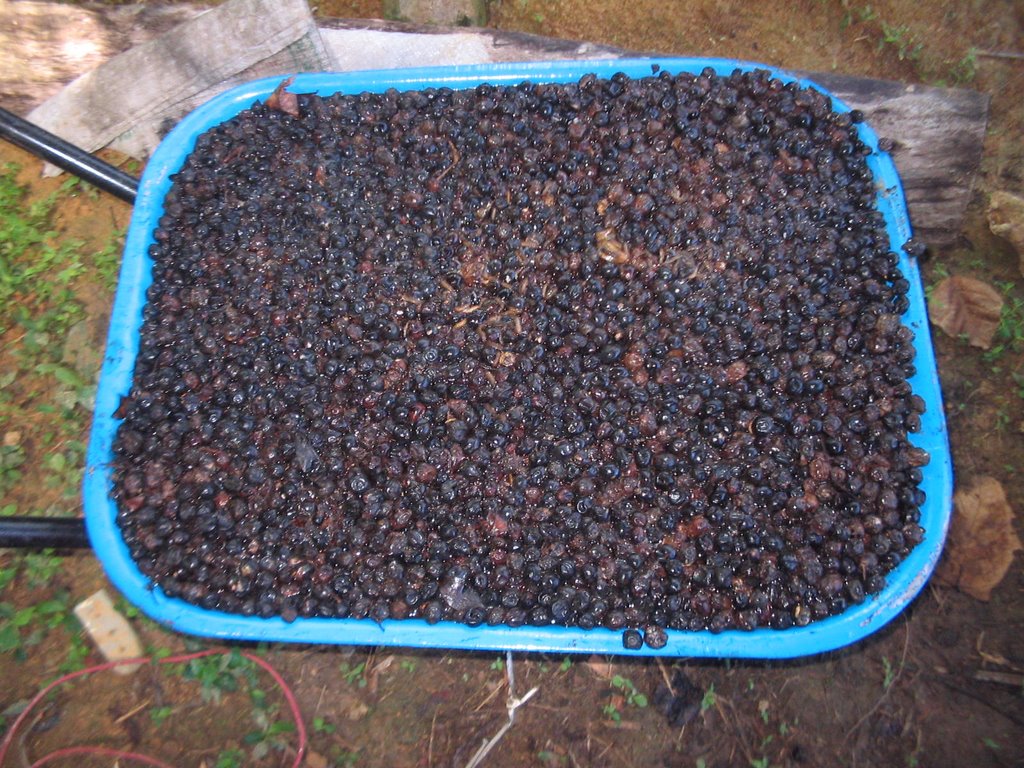


After these seeds sprout, I will put each in its own separte bag to grow for at least another 5 months. We plan on begining the transplantation project in a year, next April or May. Next month, I am going to return to Las Alturas de Coton to collect different species.

THE WORM FARM


Thomas, our friend from Michigan, is a worm farmer that sells his products in famers markets in the US. He taught us how to cultivate worms. This is the system:
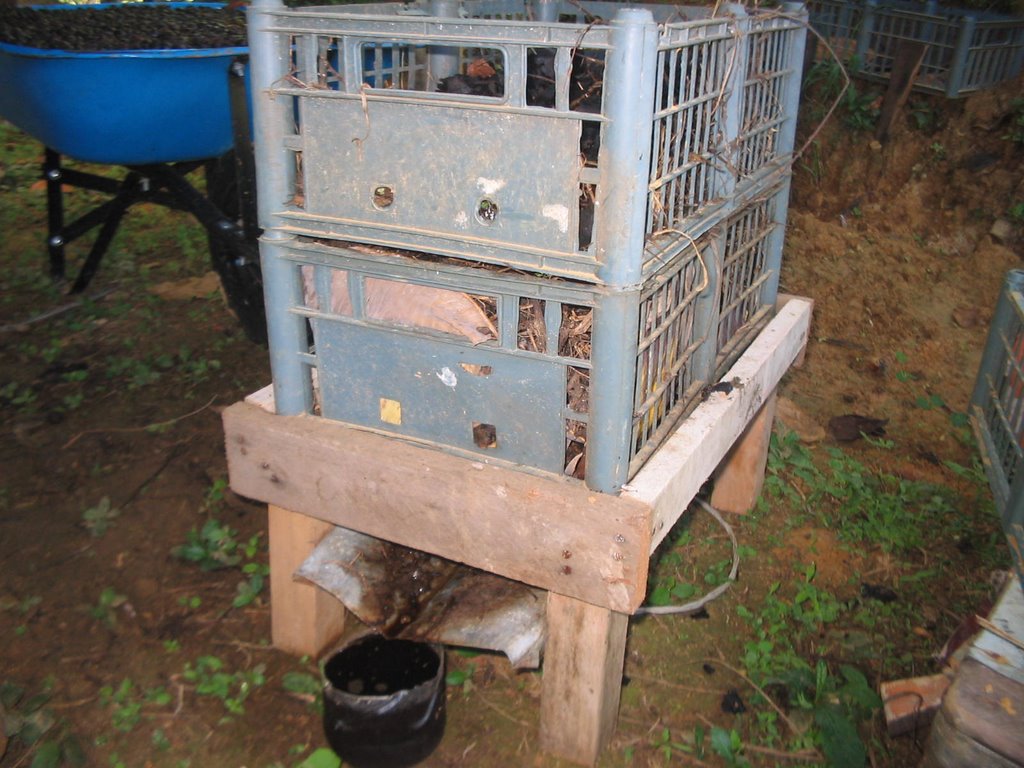


Compost goes in each basket, and as the worms eat their favorites, their poop becomes excellent fertilizer. They slowly move up to the fresher bins, leaving behind enriched compost. We keep the environment wet for them, and the excess water drips down and we collect this worm juice "jugo de lombrisas".
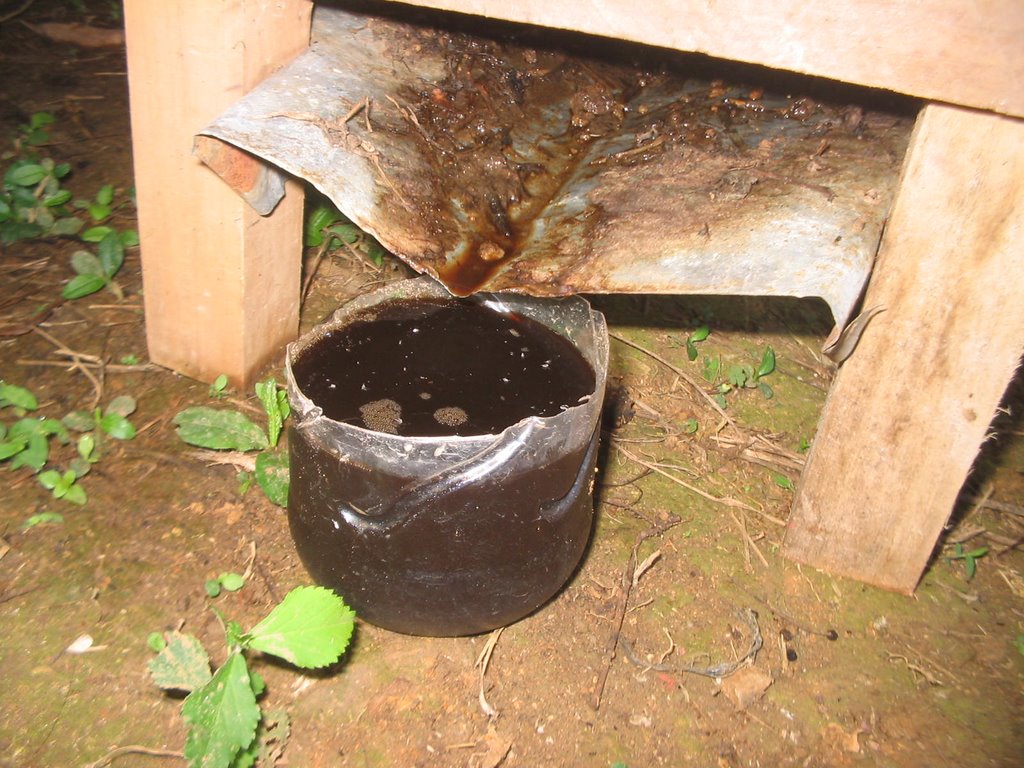


This stuff is extremely potent.

MORE PHOTOS....


This area of the garage serves a double function as a carpentry table (built by Josh Mills) and a resting place to read, drink coffee and swing in the hammock.

Im going to end the picture show with this picture out our back window.


More to come
Eliot

Monday, April 24, 2006

A Brief History of Nicaragua


La Independencia
In 1821, Nicaragua gained its independence from Spain along with the rest of its Central American neighobrs. The majority of the 1800s, Nicaragua was characterized by large land owners and an increasing US interest in transportation systems and fruit production. By the 1920s the US marines were playing the role of the Nicaraguan National Guard to protect US business interests. In 1936, the US withdrew its military presence as President Somoza was elected to power. Somoza set up a corrupt military dictatorship that would last over 40 years.

La Revolucion

In 1979, the Sandanista revolution finally ended the Somoza regime. The FSLN (Frente Sandinista de Liberación Nacional) initiated an agrarian reform, dividing up land from large land owners and giving it or selling it for extremely low prices to poor farmers. Like the story of many countries during this time, the United States would not tollerate this threat to international business, particularly to the large land owning American corperations like the United Fruit Company.

La Guerra

The Reagan administartion began a covert opperation that has become known as the Iran-Contra affair. The administration secretely sold arms to Iran to fight the Iran-Iraq war, and, with the money made on the sell of the guns, funded a right wing counter-revolutionary army (the Contras) to bring down the Sandanista regime. To Nicaraguans, this was known as La Guerra. The World Court finally ruled that this was against against international law. President Reagan publically refused to admit any knowledge of the affair, and then two weeks later made an address admitting his mistakes. Everyone indicted in the affair was eventually pardonned by the Bush Administration. The Contra army (trained by the School of the Americas) was designed to use terroristic tactics to force the public to elect a government that would be more economically favorable to the United States. It succeeded. After two years of starvation, the people of Nicaragua "elected" a government that promoted the neoliberal ideals of the Reagan-Bush-Bush adminitstrations.

With this background, it was an amazing experience to live up in the mountains above Matagalpa with farmers who had lived through these atrocities. When I asked them, they shared with me the horrors of two years of near starvation, standing in lines all day to maybe receive a scoop of rice or beans. Luckily, these were farmers who could mostly sustain themselves with their crops, but many still went hungry. They told me that the fighting never made it to their communities. Many of the boys would leave to fight in the lowlands near Managua, but most of them stayed up in the mountains to wait it out. I found it amazing that they were so hospitable to me, an American, whose government had funded this war.

More on Nicaragua to come.......

Sunday, April 16, 2006

Isla Ometepe


Easter is called Semana Santa in Latin America, and the entire week before Easter is a huge celebration. It is almost impossible to travel during this time because every bus is packed-full of relatives visiting relatives, and buses stop running thursday-monday. In the mad rush to find a boat to the island I had to convince some Nicaraguan soldiers that I was on the list of chosen people to enter the boat they guarded behind chain link fences. The entire beachfront of San Jorge that sits on the western shore of Lago Nicaragua was packed with beer, big speakers, parades, and food vendors. Magically we made it on the boat.

The island is the largest lake island in the world, and the lake has some of the most unique biodiversity. Since it is so close to the sea, many fish swam upriver including bull sharks. Over the years they have adapted to the fresh water, agua dulce, and have become unique species. The sharks have sadly almost disappeared now due to overfishing. The island is home to two volcanoes, Volcan Concepcion (still active) and Volcan Madera (not active).

My friend Josh and I came with Yelena and Joey from CAN (Community Agroecology Network in Aguabuena). We came to visit the Bainbridge-Ometepe Sister Islands Association. The org. is dedicated to aiding the island through various programs including buying and marketing the coffe from the cooperative to consumers in Washington, bringing internet services to the island, and creating an "escuela libre" for students of all ages. Thanks to the hospitatlity of its project managers, Peter and Devon, we had an amazing visit.

The coffe cooperative was hit hard by the difficult political climate of Nicaragua and world coffee market. Like the story of so many coffee towns, it used to be a thriving community but through political corruption and lowering coffee prices, it became a ghost town, now begining to be "revived" by tourism. After the 1990 elections that brought Nicaragua back to the path of neoliberal economics (if you dont know the story of the Iran-Contra affair, I suggest learning about it), the coffee cooperative was forced/coerced by the government (or the United States, World Bank, and/or IMF....) to take big loans that nearly threw them into abyssmal debt. You can check out the cooperative and buy coffee from them through www.coop-cdc.com.

It is very interesting to see the differences between Nicaragua and Costa Rica. Climatically, Lago Nicaragua is drier than Coto Brus, the home of our finca, and much hotter. Culturally, Nicaraguans seem to have more pride, more of a sense of nationality probably due to their more turbulant history of revolutions and civil wars. And economically Nicaragua is a much poorer country.

We are heading up to Matagalpa to visit the coffee cooperative up there. Matagalpa is a sister community of Coopabuena as CAN (Community Agroecology Network) works with both communities. We are going to meet up with Julietta and Walter from Coope Pueblos. It should be interesting. I will keep yall posted.

Paz y amor
Eliot

Friday, March 24, 2006

There is a war going on

Yesterday, I saw smoke above the finca close to where our spring is. I ran up to see what was happening. Across the creek, on Marcos´land, there was a big fire. He was burning an entire hillside including the branches of the tree we sadly lost months ago. It was a horrible sight, muy feo. I felt like I was looking at a ravaged battlefield.

And after I thought about it, it is a war. The war that is going on is an economic war, a war between poverty and the environment. Marcos is using slash and burn methods to plant corn. It is fairly common practice around here. The price of coffee fell so low a few years ago that it has created a certain bitterness in some of the farmers. For people like Marcos, the land is here solely to extract resources from, and he is angry at it for letting him down with coffee. Next came cattle, until there was no more pasture grass left, and now all there is is to burn it and plant corn. You can see it in the way he swings his machete, and even in the way he walks.

Maybe this sounds hyperbolic, but if you could see (i dont have a camara) the sight where our over-grown, almost forest of a farm rises above this burnt land, you would understand what I mean. It is a war. I was so upset last night, I had a hard time sleeping. I cant blame Marcos though. The problem is so much bigger. It is the coffee market, the coffee coroporations. It is even bigger than that. It is our entire economic system. When Marcos looks at the land he sees money, whether its a tree, or a charred piece of land to plant corn. And by Marcos, I dont just mean Marcos.

I felt hopeless and helpless. We came here to try to help to change this problem. When I was dreaming of moving here, I never actually saw the problem face to face. I never had to deal with it. But as I run up and down our farm to check the level of our spring, and I am confronted with this huge fire that threatens to burn me and all of our land, I realize that I have to face it. And its scary.

But then there are farmers like Umberto and Roberto who are having a meeting here in a few minutes with their group of organic committed farmers. And they are trying to change the ways here. They were hit hard by the coffee crash too, but they value more than money. They value the life and longevity of the land. It is inspring to be with them. And when I see Marcos, I have to restrain myself. I invite him over for coffee and I try to cultivate a friendship. And I realize that this is why we came here, and its going to be hard work.

-Eliot

Monday, March 20, 2006

Reforestation Project #2

Yesterday, I went exploring with William Mendez down on his creek bed to talk about reforestation. The creek that his property sits atop is the same creek that passes by our finca. He explained to me that the coffee cooperative used to use this creek as a waste drainage for the water used to rid the coffee beans of their cascaras (skins). The coffee cooperative has since gone out of buisness due to the devasting economic impact of the recent crisis in the coffee market. The creek is still very polluted. We have decided to make this our second reforestation project. Between our farm and his, there are two farms that we need to gain the support of their owners. I think that it will be fairly easy to convince them. The beauty of reforesting water ways is that hardly any one is using the land for farming or ranching, and the benefits of erosion and pollution control are hard to pass up. I gotta go catch the bus.

Paz
Eliot

Thursday, March 16, 2006

The Seeds

Las Alturas de Cotón is an old logging/coffee village at the foot of the volcanic Talamanca mountains. The town is at 1300 meters, so the air is crip and cool at night. It is not a tourist town. You have to have permission to enter. It is owned by an Estadounidense (gringo). When my bus entered the last gate there were only three of us left on the bus: the bus driver, his girlfriend, and me.

The town is very strange. There are 140 people that live there, most of whom are indigenous. Their electricity comes from a gasoline powered generator that only gives power from 5pm till 9pm. The land is adjacent to the Parque Amistad which is the largest protected area in Central America. The land that the town sits on is the largest privately owned forest in Costa Rica. The owner, Addison Fischer, is trying to make the town as sustainable as possible. They have a large reforestation project, planting 60,000 trees a year. He strongly prohibits any minerals or vegetation leaving the town, so the economy of the town solely relies on his aid, paying the 140 workers every month. The town has the feel of a tropical kingdom from some time long passed. Like I said, this town is strange.

We were first introduced to the town by Kathrin Lindell, the avian ecologist, whom we helped with the Earthwatch expedition. We met Fernando, the caretaker, who then invited us to come back this week to learn how they collect their seeds for their reforestation project. Since Brendan has gone back to the US, I went alone.

While I was there, there happened to be a woman´s workshop on building cob (clay, sand, and hay) houses. The class was being taught by Becky Bee, whose book we ironically bought right before we moved down here. I felt slightly akward because they were trying to have a completely isolated womens workshop, and I felt that I kept intruding. But they were all very nice women who were very interested in our project. They invited me to dinner everynight, and it was nice to have some gringas to talk to.

Yesterday morning, I woke up early had coffee and breakfast, and headed out at 8 with my crew of reforesteros. There were 4 of us: Roberto, the driver; Clemente, the tree expert; Carlos, his assistant, and me. They are all very campesino, so it was a challenge to communicate with them. They asked me how to say bad words in English, but there favorite thing to say was ¨beans and rice¨, which for some reason cracked them up. The first seeds we collected were Dantos. I thought we would have to walk through jungle to find them, but they were all on the road. We collected "un pichaso de semillas" (a shitload of seeds). The seeds of the Dantos are like big grapes, they taste sweet. Danto is a tropical hardwood that grows at higher eleveations. Apparently the wood is worth alot. We also collected Nogales (Nicaraguan black walnut) and Marías (another valuable tree for lumber).

I felt very lucky to be able to go there. It really is an incredible place. And I am so excited that we finally have our first seeds (probably over 1000). We will begin germinating them in May and then they will be ready to plant in 6-10 months. We already have our first reforestation project. We are going to be working with the coffee cooperative here, Coope Pueblos, to recuperate the Rio Salto, one of the main rivers in Aguabuena. As soon as I got back, I had a meeting with Walter from Coope Pueblos and Roberto Jiménez. They were very excited. They truly appreciated our efforts to help. It almost brought a tear to their eyes when they started talking about the changes that are taking place in "la mente de la gente". They feel that one of the most important aspects of the project is changing the consiousness of the people.

More later, I gotta go

Paz y amor
Eliot

Wednesday, March 08, 2006

Battling the Bats....and other difficulties

We finally moved into the farmhouse! But of course ther are some problems......

THE BATS
There is a bat that lives in our house. It poops from the same rafter every night, in the same spot of one of the bedrooms. The first night we moved into our house we were scared to sleep in that room because we were told that it could make us sick, or more likely would suck our blood. So we sleep in the living room.

We were told to tie a red shirt to the spot where it shits and to surround the house with garlic because bats are scared of red and cant stand garlic. I thought maybe vampire and bat mythologies were getting mixed up, but we had to do something. It worked....sorta. The bat got confused at least. Instead of its favorite spot, the bat pooped on my bag. But I think that our psychological warfare is going to win in the end, altough you can still hear it batting it wings against the window when it gets trapped.

THE WATER
The other day we ran out of water. We had to jog our memory from physics classes about fluid dynamics, sipehns, and water pressure. Its hareder than we thought to rely on spring water for everything in the height of the dry season. We have to be extra mindfull on how we use it. And its DIRTY. We have to treat it to drink it. Eventually we are going to need a water filtration system.

THE FURNITURE
We have no furniture. Flor and William gave us a bench which is awesome. But we have no table or any other seats. We just use our matresses that sit in our living room because we are still scared of the bat. Today we are going to start building furninture. We will have pictures up soon.

---------

Anyways, Brendan is heading back to the States this weekend. Then I (Eliot) will be here all alone. We should have some pictures up when Brendan gets back.

Pura vida
Eliot and Brendan

Monday, February 27, 2006

The Birds

This last Saturday, Brendan and I were lucky enough to be invited to join the biologist, Dr. Kathrine Lindell, to assist in an Earthwatch expedition looking for the presence of birds to assess the success of experimental restoration/reforestation plots created by Dr. Karen Holl.

We woke up at 4:30 so that we could be out in field by the time the sun rose when birds are most active. We set up nets to catch the birds to tag them for future studies. The site where we were working was one of the weaker plots that Kathrine was working with. We only caught seven birds in five hours. Kathrine´s hypothesis was that it was too windy in this one area for the trees to grow well.

Either way we were excited to see the birds we caught. In the end we only caught three species, a cherry tanager, a Tenessee warbler, and a snow-bellied hummingbird. We couldnt believe that the tiny little warbler had flown all the way from its nesting site in Alaska. I had always heard about migratory birds, but its a very different experience when you hold one in your hands.

Hopefully we will be able to post some pictures up soon, but the internet is very slow down here. We have to run to catch the bus. More to come.......

Paz y amor
Eliot and Brendan

Friday, February 24, 2006

The Begginings


Brendan and I (Eliot) have been in Costa Rica for a month now and everything is coming along great. We have been staying at William and Flor´s house. Flor has been cooking us her wonderful meals. Its been great to be back with the family. Tomorrow our house will finally be ready to live in, although we still dont have any furniture or appliances.

OUR FIRST DAYS
When we first got here we were told that the roof our our house had been stolen, a window broken into, an old sink stolen, and a fire built in our living room. We werent too surprised. It was probably some teenagers that dont have much to do at night. We needed a new roof anyways, so the theives had only helped to get rid of the old one.

What we hadnt expected that first day that we walked down to our farm was that our one beloved old growth tree had been cut down by a neighbor to make a few thousand dollars for the lumber. It took us a second to realize what had happened. At first I kept thinking I saw the tree, but when we finally bushwacked our way to the spot where the old tree used to stand, it was just a stump.

Not only had our neighbor cut down the tree, but he had also fenced off the common spring we share with barb wire on our side of the creek that divides our properties. We were depressed. It greatly affected us. But at another level it reminded us of why we were here, to plant trees and help relieve the economic pressures that lead to deforesestation. Since that tree was cut, the spring that pours out from under its stump has dropped 50 percent. Trees are so important to maintain clean and healthy water systems.

The next day we were working on our roof, and our neighbor, Marcos (who had cut down tree), came up to us. We had never met before. He immediately began telling us very adimantly that our garage was built on the public road (calle publica). We remained very calm, trying to explain that the garage has been there for over fifteen years and that there was no where past our house that one could drive because it dead ends into a very steep hill just past our garage. We had to hold back from accusing him of cutting down our tree and fencing off the spring. We politely agreed to talk to someone from ¨la municipalidad¨ to settle the dispute.

The next week we met with a man from ¨la municipalidad¨ and Marcos. We agreed that while our garage is technically in the "calle publica", it is old enough to remain there as long as we were just reconstructing the house, not building a new foundation. We also agree that the spring is both of ours, the fence is to be in the middle of the creek. Marcos understood that the tree was ours but he claimed that the wind blew it down (hard to imagine).

Since then we have more or less made friends with Marcos. He has agreed to let us plant trees on his side of the fence to help restore the spring. That spring is now our only source of water. When we tried to get city water from AYA, they told us in a very confusing labyrinth of latino beaurocracy that we would have to buy new pipes for the entire neighborhood. It would have probably cost over 1000$U.S. So we just decided to use our spring.

So our house is almost ready to live in. We picked out tiles. We have new windows and doors. We are creating a biodigesting toilet that will capture the methane from our ceptic tank to power a stove for us to cook from. We have never heard of anyone doing this with human manure, so its a little bit of an experiment. We are excited to see how well it works. Since there are only two of us here right now, we will have to suppliment the ceptic tank by adding the manure from chickens, goats, and cows.

We have already made connections to start getting seeds for our reforestation nursery. Next month Brendan is going back to Oakland to make some more money, and I am going to go seed gathering. I already know it is going to be a great story, so youll have to keep tuned in.


This is a picture of the remnants of the tree we lost.

Paz y amor
Eliot and Brendan