Tuesday, October 17, 2006

Harvest Time

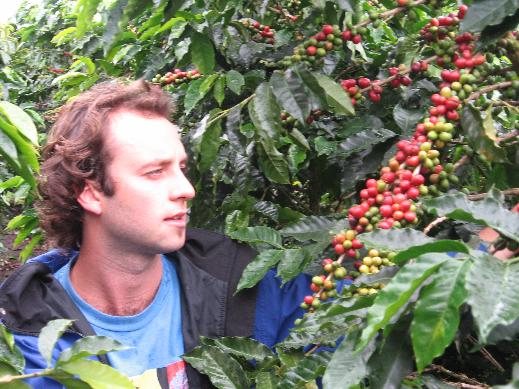
The coffee berries are getting ripe, but the Cooperative still doesnt have a functional beneficio. The beneficio is supposed to start processing the coffee next week, but there is still a lot of coffee to be processed in the mean time.

Coffee has to be processed within 24 hours of harvesting. This makes coffee a difficult crop to deal with as it adds a great deal of transportation costs. Every day the ripe beans have to picked and taken to the local beneficio (processing plant). The beneficio washes and removes the skins of the beans so they can be dried and stored for roasting at a later date.

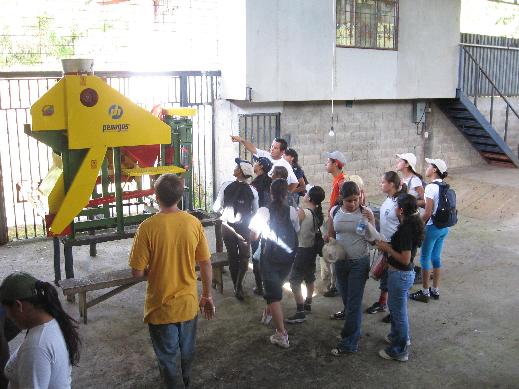
Since the Coopabuena beneficio closed down two years ago, the new cooperative (Coopepueblos) has been without a beneficio, taking the raw berries to be processed by the nearest beneficio in Sabalito (13 km away). This added alot of costs to last years harvest. This year UCSC researchers, Karen Holl and Rebecca Cole, loaned the cooperative $6000 of the $10,000 needed to buy a micro-beneficio. It arrived a few weeks ago, and the cooperative has been hard at work getting it ready for this years harvest. It should be up and running by next week.

Este beneficio es puro columbiano!

Monday, October 16, 2006

Rainy season is here

Up until yesterday, it seemed like the rainy season would never come. This is our first rainy season to spend down here, so we dont know what it is like. It is supposed to start at the beginning of October and last until December, but for the last two weeks it has hardly rained at all (only like every other day). All the farmers we talk to mention how dry it has been. Flor said it has been dry because of El Niño.

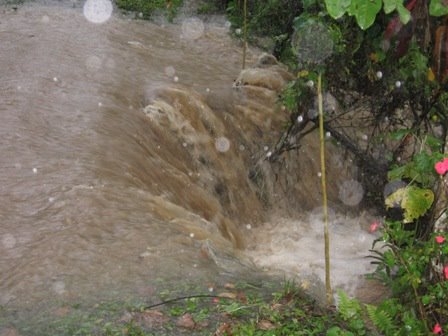
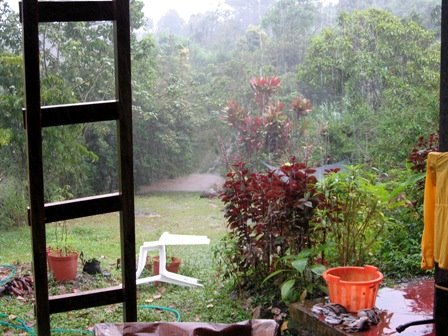
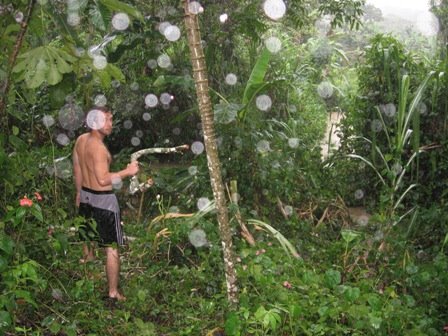
But yesterday it RAINED. The day started beautiful and sunny, but by noon it was sprinkling and by 1 it was pouring. Brendan and I were working on our plan for next year, typing on the computer, shouting over the pounding rain on the tin roof. At one point, we looked out the front door, and the bridge to our farm was flooded. We were stuck on our farm. This was the first flood that had reached over the bridge. We ran outside taking pictures. It was cold. The flood almost got to our seedlings, but they were safe luckily.

Right now it is raining again and the sky is a very strange orange. I think the rainy season has finally come.

Monday, October 09, 2006

Treking up the Rio Salto

On Friday, Eliot and I met with Jovenes Ecologicos to explore the Cuenca del Rio Salto (River Salto watershed). This ecological youth group was created to introduce youth to environmental issues through local field trips, eco-activities and group discussions. This was our first outing with the high schoolers and it was a great success. We treked 5 kilometers up stream, ending up at the 20 meter waterfall which feeds the river. It was a suprise to me that the majority of the kids had never seen this waterfall, or a monkey for that matter. At the waterfall we had a discussion about the importance of a forested watershed and how it filters and protects the water resource.


We then hiked up above the waterfall to have lunch under a shelter. We talked to the kids in English so they could practice their skills. We talked about this upcoming year, planning for our High School Cultural Exchange Program. They were excited to share experiences like this trip to the waterfall with kids from the US. When we asked them what else they would like to do...they came up with some crazy ideas like tug-of-wars in the mud and karaoke comptetions. I think next year will be a lot of fun.

Monday, October 02, 2006

Jovenes Ecologicos

Part of our new responsibility in the “Grupo Ambiente Saludable”, is creating a group of high school students called “Jovenes Ecologicos” (Ecological Youth). We are going to be facilitating projects that these students want to carry out to improve the environment. We will give them the power choose what kind of ecological projects they want to do, and we will be there to help them. The big idea of this “Ambiente Saludable” movement is to attract tourists to Aguabuea if the community can gain the “Bandera Azul” (Blue Flag) certification. The region of Coto Brus is one of the least popular destinations for tourists in Costa Rica, but this is probably going to change soon.

Today, we interviewed 23 “Jovenes Ecologicos” to pick 15 tourists guides that we will train to encourage ecological literacy. It was hard to choose. The students ranged from 8th-10th grade. We judged them on their use of English, their enthusiasm, and their knowledge of the area. Some of the students speak very well, and it was easy to pick them. Some of them were shy and quiet, and it was hard to figure out if they were just terrified by the inquisition-like questioning we inflicted upon them. We were a panel of judges (Eliot, Brendan, Jacob, Trina), and the students (one by one) sat across from our panel in an otherwise empty class room while we drilled them. We asked them: 1) Tell us about yourself. 2) Why do you want to be a guide? 3)What is your favorite place in Aguabuena?

After eating lunch in the cafeteria (beans, rice, eggs, cheese, salad, and a tortilla), we met with the principal and the secretary to announce the winners. All the potential guides were waiting outside the office for the announcement. We had a mix up between a girl named Adriana and one named Andreina. We had to retest them. Even though Andreina had a higher grade average, we chose Adriana. We were given all of the students grades and GPAs, although I made it clear to the principal that that was not a deciding fact for us.

Tomorrow we have our first meeting with the elected Guides.

Wednesday, September 27, 2006

Ambiente Saludable

On Monday, we attended a meeting of Associacion Desarrollo Aguabuena (Association of Development) over making Aguanbuena “un Districto Ecologio”. These Ecological Districts are a certification for communities as a way to attract tourists. The meeting was the first of a series where we elected councils to address certain needs of the community. The needs were as far ranging as an ATM machine for the town to protection of watersheds. We were elected to the “Ambiente Saludable” (Healthy Environment) council to head the Reforestation committee.

We will be working with Carlos, the president of the Association; as well as Walter, manager of CoopePueblos; a representative from AYA, the national water company; the entire local police force, and our Peace Corps friends, Jacob and Trina. Our goals are to protect watersheds, create reforestation projects, and create trash clean-up and recycling programs.

It’s an awesome feeling of how we are becoming more connected to the community here. This was the first meeting we attended where they addressed our project, “Finca Proyecto”, during the meeting. Carlos and Walter were really excited to work with us, and we were patting each other on the back saying “Ambiente Saludable” as if it were some secret society or fraternity that we are now apart of.

The first official “Ambiente Saludable” meeting is next Tuesday, at 3pm.

Monday, September 18, 2006

el murciélago

Since we moved in to the house,
we have not been alone. We have had a bat, un murciélago, that has been living in the back room (the bat room). He has pooped (or guanoed) all over the bat room and walls throughout the house. It has been a constant struggle, cleaning up bat guano, fearing the flapping over our heads as we fall asleep, and the possiblility that he could be a chupesangre (blood sucker). Last Friday, we caught him.

I (Eliot) was in the living room. It had just gotten dark. The front door was open. Suddenly the bat flew through the front door, in to the house, straight to the back room. I shouted to Brendan. The bat was flying like crazy, bumping in to the walls. It flew into the bathroom. I grabbed a towel and threw it at Brendan.

"What do you want me to do with this?"

"Catch him."

Brendan threw the towel on top of the bat. And that was that. We caught the bat.

Since we moved in to the house, we have tried so many things to get rid of the bat like hanging garlic from the ceilings. Supposedly bats hate garlic and the color red. Everyone in town told us we should poison it or just find someway to kill it. We didn´t want to kill it though. We had never thought of catching it.

So we decided to build a house for it. We feed it platanos and it hangs from two coffee branches (upsidedown of course). We dont know what we are going to do with it. We have thought about letting it go somewhere, but they say that "the bat comes back...the very next day". For right now, its our pet. Although it kinda freaks me out.


Pura Vida
Eliot

Thursday, September 14, 2006

Environmental Responsibility

A few days ago I visited the elememtry school in Agua Buena to talk with the students about environmental responsibility. Our friends Jacob and Trina (who work with the Peace Coprs) invited Eliot and I to participate in the values program they have been teaching in the schools. Among the values were responsibility. Since Eliot had to return to the US for a bit, I gave a talk about the importance of environmental stewardship. The kids were excited and had a real interest in learning more. Most of the kids have already been exposed to more environmental education than elementry students in the States.


Once the discussion was over, I split the kids into groups, and we went outside to plant trees in the back of the school. The kids were energized as the older students (6th graders) helped the younger students (1st graders) clear a spot and dig the hole. We planted 6 trees in total. Some of the kids put rocks incircling the trees to protect them. They even realized that the most important part of reforesting is protecting the tree from being cut down or harmed. It was really touching to see them caring for the trees. And to top it off, the kids who finished first went around the school yard and collected all the basura (garbage) they could find.

Many school sites in the surrounding community have land in need of reforestation. We have talked with several principals (directores)about supplying saplings and planting trees with the kids. These meetings have led us to consider schools as another area where we would like to focus our reforestation efforts. It you think about it, there are lots of similarities between an erroding riverbank and a barren schoolyard. In one instatnce you have nutrient-rich top soil being washed away, increased flooding, and degrading water quality. On the other hand you have kids learning in a place that does not refelct a healthy environment which increases the chance of environmental irresponsibility and ultimatly the quailty of education. Yes it may be cheezy, but i believe that the kids of today are the topsoil of tomorrow. We all must restore the quailty of environmetal education throughout the world while simultaneously restoring our ecosystems.

Wednesday, September 06, 2006

An insightful trip to Pamama

I just returned from an amazing trip to Panama. Dan and I visited Panama City for three days. We took the midnight bus from David and arrived in Panama City early in the morning, just in time to see a "Panamax" cargo ship cruz through the locks at Mira Flores. This is the name given to ships that are built to the maximum width and length of the canal. There is little clearance on either side of the boat. The canal opperates 24 hrs a day, 365 days a year non-stop. The experience enabled me to better imaginge the amount of consumption that exists in the global North, especially the United States of America. On top of this, the Panamanian government has a "Master Plan" to increase the size of the canal, to detour competition from springing up, among other things.

While the canal was grand, it was less helpful than the Biblioteca (library) at the Smithsonian Tropical Research Institute. Here I found three floors of books, many of which contained insightful information. I could have spent all day in the building; but they closed at noon, and we still had much of the city to see. We also visited the Jardín Botánico de Gamboa (Botanical Garden) where we met the Chief of Environmental Education, who later invited us to stay at his apartment for the rest of our time in Panama City.

We left the city and headed toward the highlands. From David we went north toward Boquete, a romantic mountain town with coffee-coverd slopes, lies at the base of Volcan Baru. Here we visited a well-maintained garden, where I collected seed of species that would attract butterflies and bees. This town is known for thier abundence of flowers amongst the coffee trees. Boquete was a nice break from the heat of the lowlands.

Returning back to Agua Buena, Dan is preparing for his deparute back to the states and I am waiting on Eliot's arrival.

From the farm,
Pura Vida
Brendan

Wednesday, August 30, 2006

Caca De Vaca


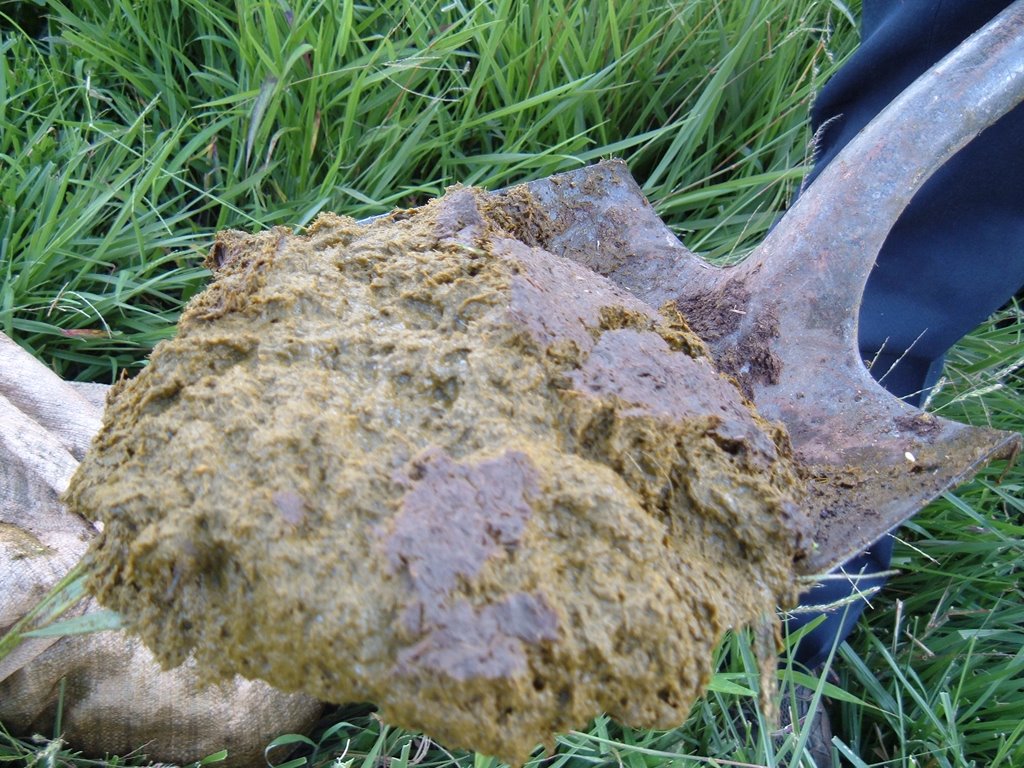
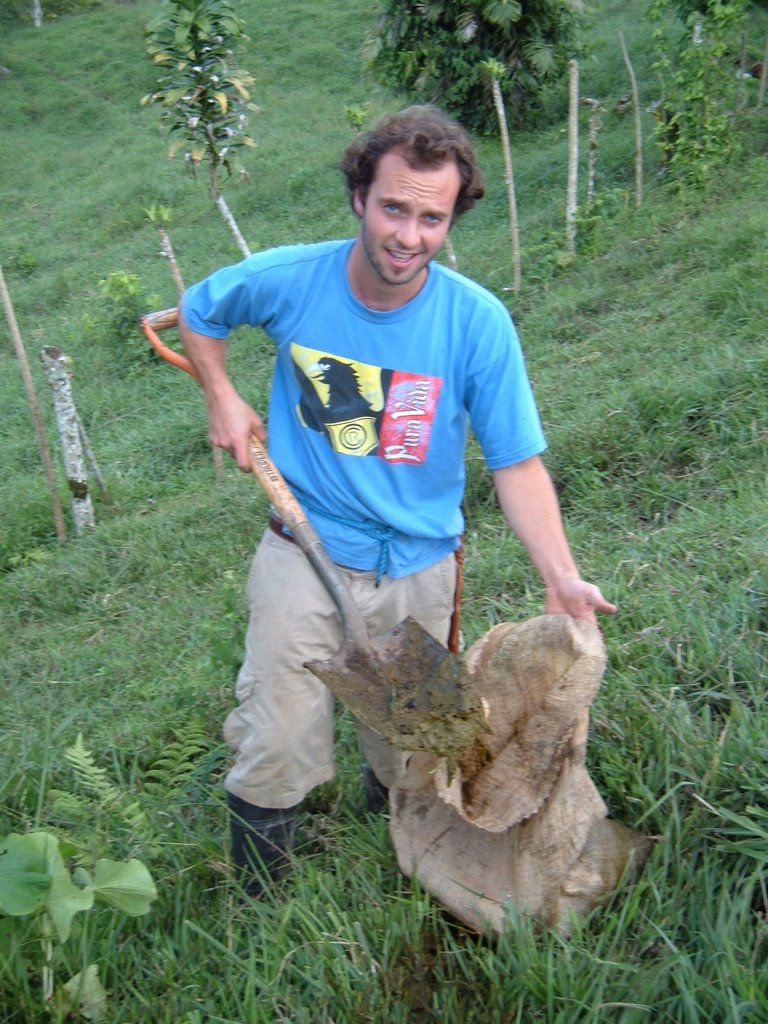
Yesterday, Dan (our intern) and I went up to the "company" farm on the north side of our finca. Sometimes Eliot and I would find ourselves here to watch the sunset or view the valley to the south, but this time it was for other reasons. As Dan and I climbed to the top of the farm, we crossed over the barbed wire into the pasture. We were surounded by vacas (cows), and...well, we had come to collect their feces. As we passed up cow pie after cow pie, Dan exclaimed, "why are we passing up all these piles? you sure are picky about your cow shit." He was right, I was in search of the freshest cow shit I could find. When I found the piles still warm from the metabolic processes recently incurred upon it, I exclaimed "we got freshies", and we proceeded to scoop, bag and move on. We were collecting caca for our biodigestor, which contains excriment of various animals and captures the methane that is released when the organic compounds breakdown. This is a low-tech system that has been in practice for centuries. As the gas accumulates in the plastic bag above the tank, it becomes pressurised and is piped to the outdoor kitchen. Here it is connected to the stove and we are able to cook for hours.
The only problem with our system is that we dont have enough excrement for the system to properly function. After we collected two coffee sacks worth of caca de vaca we proceded to drag the oozing bags home and fill the intake tube to the biodigester. In about 1 hour we collected 50 pounds of cow feces, and we accomplished the mission without angering the bulls.

Saturday, August 26, 2006

Kids excited about Reforestation

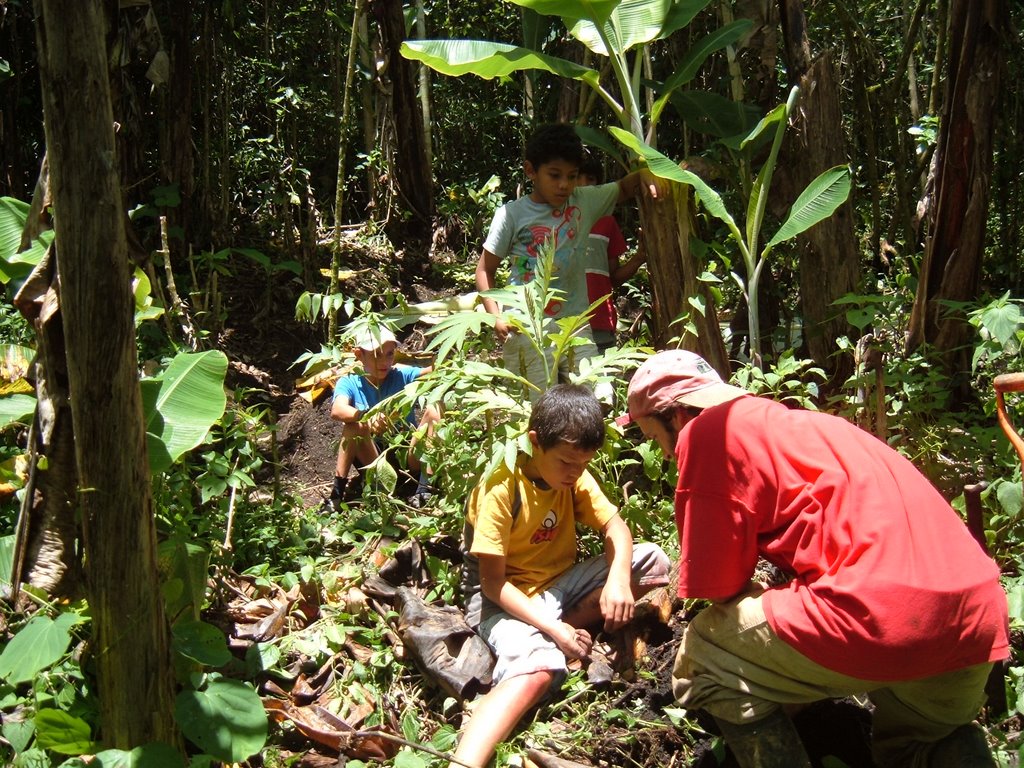
One day Eliot met some of the local kids at the elementary school and invited them down to the finca to show them our seedling nursery. A month later the kids showed up wondering why we weren't at the farm that morning. I reminded them that that we had invited them a month ago, and things do happen sometimes. Since then the kids have become really excited about trees, and come over almost daily wanting to help us. Sometimes they even teach us a thing or two. When Greivin (10 yrs old) shows up with his brothers Luigi (7) and Jhonny (12..and thats how he spells his name), they almost always bring seeds. Some seeds are endangered species that we havent even found yet.


Being around the kids has reminded me of how, as we get older, we become estranged from our fundamental connection to mother earth. Showing the kids how tamarinds sprout or talking about the monkies and snakes that we've seen genuinely excites them. The excitement is contagious.


I believe that the youth still posses an inherent connection to the environment, born with a love for their environment, instead of a need to dominate it. If we can harbor and develop this passion among children, we are that much closer to reparing what our forefathers have squandered. Cheers to the YOUTH!!!


Pura Vida
Brendan

Friday, August 25, 2006

Learning from the Masters: Farmers teach us how to make and mix suelo

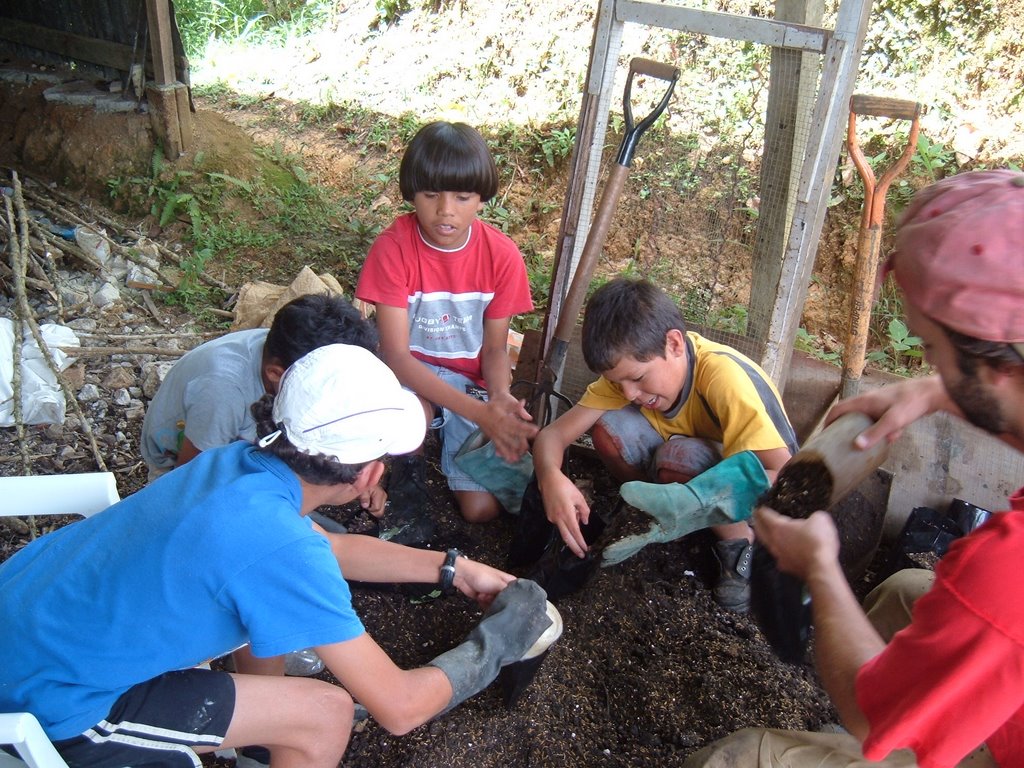
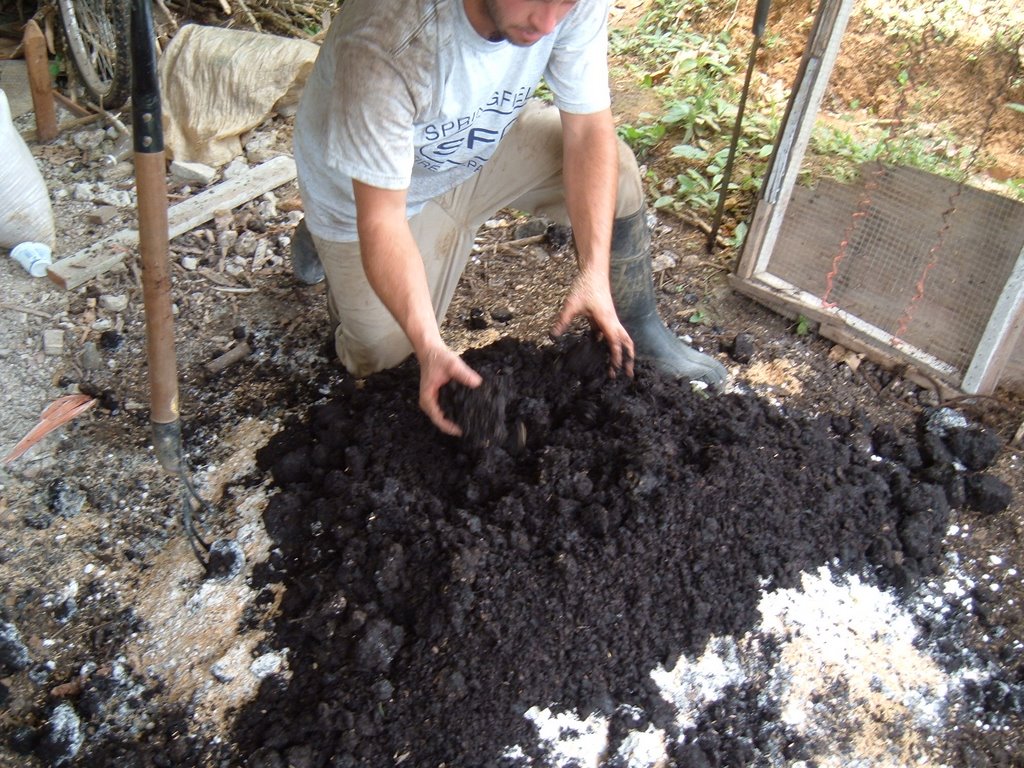
The pictures below illustrate the process of mixing soil practiced by many local farmers. This soil recipe has traditionally been used for small coffee trees. This specific method was tought to us by our neighbor, Harold. This is what we use for our seedlings.

Step 1
Start with a base of 1 part topsoil from the farm, then from into a flat-top mound

Step 2
Add a thin layer of cascara de arroz (rice husks)untill it totally covers the topsoil

Step 3
Add a thin layter of Cal (Calcium) in the same manor as step 2


Step 4
Add 1 part brosa de café (composted coffee husks), and crumble by hand


Step 5
Repeat step 2 and 3


Step 6
Mix, making sure the moist brosa de cafe is fully broken down


Step 7
Fill the bags, give it the ol´ pound and shake to ensure a well-filled bag


Step 8
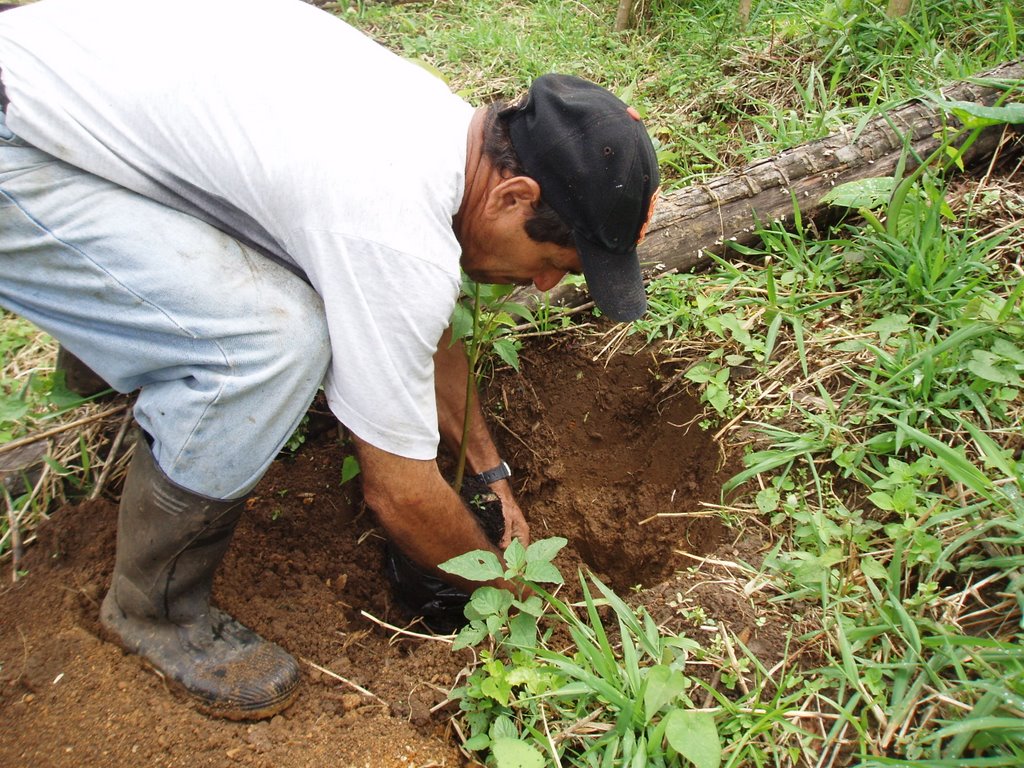
Transplant the seedling


This method has been practiced for generations and has ensured the health and nutrient demands of millions of coffee seedlings, (while they wait in the shade to be planted).

Monday, August 21, 2006

Time to Plant... More Questions Sprout

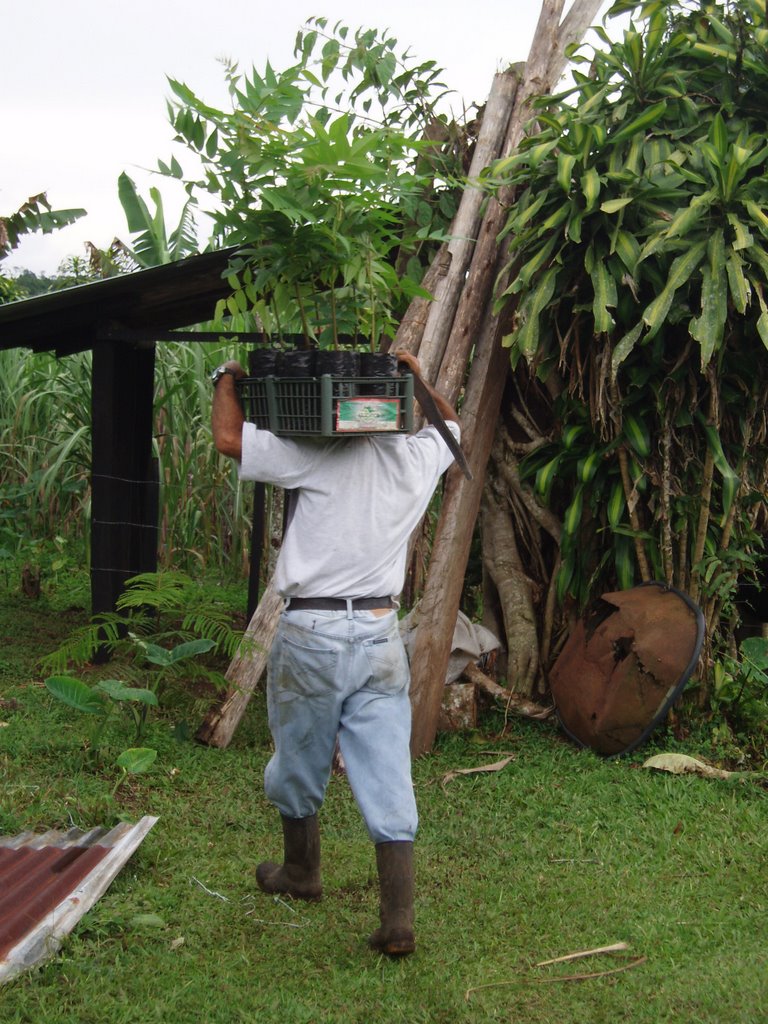
La Cunicula (the name for the weird weather period in July and August) is over and its time to plant. We have 120 Nogales (Black Walnut) bagged-up, ready for distribution. William Mendez (pictured here) came by this morning to pick up his order for 33. ¿Que vale? After numerous reminders that we are providing a free service to the community, he still asks me how much they cost. He was happy once again to hear that they were free. Tomorrow I’m going over to help William put them in the ground. We will be reforesting the riparian (river ecosystem) hillside on the south part of his farm. These fast growing species will grow tall and extend their roots into the bank of the river, helping to combat erosion, while the leafy canopy will provide shade protecting the soil from too much sun exposure.

On Wednesday I will deliver another 30 Nogales to Roberto Jiménez, who has part of his land under restoration. A farmer with decades of experience, Roberto said he really loves the Nogales. He told me yesterday that the majority of trees that were planted for reforestation have died because they were so little when they were planted. He was happy to hear that our Nogales are 2-3 feet high and well established. The roots are actually breaking through the bottom of the bag. Roberto asked me if I could help plant the trees because he is still recovering from his kidney stone operation. "Por supuesto", of course, I told him.

Since Finca Project has begun distribution, everyone has been asking how much the saplings cost. After reminding people that they are free, they began "selling" like hotcakes. I paused to think about the consequences of our project. We obviously want to get as many trees out into the community as we can, BUT it wont do much (long-term) good to give away trees to farmers who are going to cut them down in 5 or 10 years when they have some sort of economic value. We also don’t want to undercut local nursery business by dissolving the market for hardwood, fruit, and shade trees. The closest substantial nursery is in San Vito, which is half an hour away, and I´m sure there are smaller ones all around. This calls for market research. As for creating incentives to alleviate pressures to cut down trees, well, that’s gonna be tough to figure out. Some things are out of our control, and finding community-level solutions to problems caused by global economic structures will take creativity, ingenuity, and commited community interest. For now, we will begin to formalize the distribution process by enrolling farmers in our micro-reforestation projects, which involves a meeting to review guidelines for participation. This will, at least, ensure understanding of our project and reinforce the specific beneficial details of micro-reforestation in general.

So long from the Farm,
Pura Vida
Brendan

Monday, August 07, 2006

A New Intern: Worms and Trees

We have a new intern from UC Santa Cruz. Daniel Farber is doing an experiment on the use of worm compost as a fertilizer on our tree seedlings.


Daniel is doing his experiment on our manzanas de agua, Syzygium malaccense. This is a common fruit tree with shallow roots. This tree has value to our reforestation project because it helps protect water sheds by holding the water level high, and it provides an edible fruit to local farmers.


Daniel is using 100 seedlings for his experiment. For his control, he has put half of them in bags with a standard mixture used in coffee nurseries of dirt, rice husks, brosa (coffee husks), and calcium. The other 50 seedlings were placed in a bag with half of this mixture and half worm compost from Humberto Nuñigas worm farm.


Daniel measures the trunk and the leaf span every week. He will be measuring for a total of 7 weeks. This information will be valuable to us as we expand our own worm compost production and seedling nursery. Humberto Zuñiga promises us that worm compost is the best abono (fertilizer) there is.

Thursday, August 03, 2006

Back to High School

Today I went back to high school. I was invited as a judge of the 5th Annual Aguabuena Bilingual High School English Festival. Actually I was invited as a member of the "jury". We had to score students on speeches and songs. We had our own panel, each with a bottle of water and a handmade souvenir to remind us of this special day.

I should have known better than to show up on time. I met Jacob, one of the two Peace Corps volunteers, on the road heading down to the high school. His wife, Trina (the other volunteer), was sick. For a long time it looked like we would be the only "jurors". We ended up waiting for over a hour for the teachers to set up all the microphones, speakers, computers, and projectors. I was surprised at what technology the high school has here. Many of the students used Power Point to give their speaches.

The two students that won the speech contest both used Power Point. One was a girl in the third cycle (10th grade, although there is no 12th grade here). She gave her speech on health food vs fat foods. (maybe fast foods). She spoke mostly of McDonalds, which I found strange since the nearest McDonalds is 4 hours away in Panama. The other student that won for the fourth cycle (11th grade) gave his speech on the history of vampires. I really liked it. There was also a singing contest but only two girls competed. And there was supposed to be a drama show, but the students never showed up.

There only ended up being 3 of us jurors. The other one was an exchange student from Australia. It was hard to pick the winners. In the end, the three of us went up on the stage, and I announced the winners on the microphone. Everyone applauded, and I felt like a rock star.

Then we ate lunch with the principal and all the English teachers. We talked about our project. The teachers were very excited to work with us. It looks like next year we are going to have alot of support from the high school here for our reforestation projects. As we left the school, I found a nogal tree that had just seeded. I collected a bunch of seeds and walked home. It was still sunny at 12:30.

Friday, July 28, 2006

Problems Finding a Market

Yesterday was the first day of our first orange harvest, cosecha de naranjas. We have probably, I have never counted them, but probably over 100 orange trees. Most of them are on top of the hill that is our farm and have been taken over by 7 years of neglect, returning it to some sort of jungle - an orange jungle with bananas and plantains and coffee that pop out at you as you liberate them with your machete from intrusive vines and trees that turn into vines (or vines that turn into trees). I don’t really know what to do with our oranges. We have so many. I pick them while they are still a little green. There are tons of bugs, fungi, squirrels, birds, and poachers that will get them if I wait too long. I made orange juice yesterday. It was awesome. We have this metal pump-looking citrus juicer, that isn’t very efficient for high quantity juicing, but I made enough to give the Mendez family a big bottle of it.

They asked me if I am going to sell oranges. Tal vez, I said. Maybe I will sell it to Victor, William and Flor´s son-in-law. He is a verdurero who sells vegetables down in the low lands and on the Panamanian border in Ciudad Neilly, Paso Canoas, Laurel, La Cuesta, etc (all formerly United Fruit Company towns). He buys most of his vegetables and fruit from Cartago and Alajuela, the major large-scale agricultural centers of Costa Rica just outside of San Jose. These vegetables travel 8 hours on a truck to get here up in the mountains, where then Victor pays a high price, loads them up in his truck, and he drives 1-3 hours down the mountain to sell thm. Oddly, most of the vegetables he buys from San Jose are grown here as well, and he could buy them from the farmers here for much cheaper. So why doesn’t he just buy them from the local farmers? or why don’t the local farmers just sell locally anyways? why would I have to sell my oranges some where at least 1 hour away?

The people here are accustomed to this reliance on the large-scale producers because there is consistency. Ok, that makes sense. So the small scale farmers who live in this region can sell to some verdureros, but at prices half as much as the verdureros will pay the Cartageros. The farmers here just sell there products as a minimal supplement to the corporate-run agriculture of San Jose. So everytime I have this conversation with local farmers, I get sorta upset in my gringo-seeking-freer-fair-trade and I say so then why don’t we just start our own market here in Aguabuena…. We can sell our oranges. We can show off our seedlings and motivate people about reforestation. It would be beautiful. But then Julie tells me that the people here wouldn’t like it. They are too accustomed to going to house to house for what they want. Calos Porras for milk, William Mendez for chayote or cilantro, etc. But then Humberto Zuñiga and his association ASOCOPRODE (Association de Productores) are very excited about the idea of a feria, kinda like a local farmers market. Anyways I am pushing for the feria, we will see what happens. And most likely things are going to change when TLC (tratado de libre commercio), the Costa Rican side of CAFTA is ratified, although most people here think that this future looks grim.

Thursday, July 20, 2006

A Day in the Life...

.....of a reforestero

Because I frequently am asked, "So Eliot, what exactly do you do down there?" or "What is a typical day like on the farm?", I decided to give a schedule of what I did yesterday....all days being more or less similar. (Although yesterday seemed like a long day)

Wednesday, July 19th

7:00 Woke up. Made coffee. Ate breakfast - granola, yogurt, and papaya. Read for one hour.

8:00 Washed my clothes by hand and hung them up to dry. It was deceivingly sunny.

8:30 Tended the worm farm. Watered the worms. Checked the compost. Checked on the trees. Realized that I had run out of bags to transplant trees into. Became worried that the trees needed to be transplanted soon. Relaxed because I realized once again that they are trees, and they want to live. Found some hardwoods had sprouted that I was worried never would. Became happy. Checked on the vegetable garden. Wondered why some kale leaves look like they were cut in half. Was it a bug or a falling guava? I had to fill up our biodigestor with more water. It smelled surprisingly bad.

10:00 Started to cloud up. Was worried it would rain as hard as it did the day before when I was stuck in Aguabuena because the road to Coopabuena had flooded over. A UCSC student came by, sortof lost (as usual), and asked if I could help with with his research project. We brainstormed. He decided he would research different fertilizing methods used on our seedlings.

10:20 Told the student that I had to take a shower and he should just sit there and think about his project. Showered. Dressed. Took my clothes that were not dry and hung them up in the garage.

10:30 Walked with UCSC student to my neighbors, Harold, to ask him to explain to Daniel (the student) what kind of fertilizer is usually used on coffee seedlings. Just dirt, rice husks, and calcium.

10:45 Walked with UCSC student to Coope Pueblos office for an HTML lesson given in gringo spanish by a student from Evergreen. Walked instead of rode my bike because I had left my bike in the office the day before because of the flood.

11:15 HTML lesson. Learned about tables "Mesas".

12:30 Checked email. Ate fried chicken for lunch at the fried chicken place next to the office. (I hardly ever eat out but I was starving).

1:00 Rode bike back to Mendez house to meet with Becky, Ian, and Julie to talk about restructuring the CAN internship program. Talked forever. Drank coffee. Came up with idea that I will lead a seminar every week for students. Started raining very hard.

4:00 Went to Ferreteria (hard ware store) to ask about bags for the trees. They didnt have both the sizes I needed.

4:30 Went home. Ate dinner early - beans, rice, salad, spinach quiche.

5:30 Headed back to Aguabuena to start English class.

6:00 Helped Peace Corps teach "curso de ingles" to 50 students aged 8-50. The 12 year old boys were better behaved and made paper hats instead of airplanes this time.

8:30 Went to Robertos Bar with the Peace Corps volunteers. Had two Imperials. I dont drink very often but English class is rough.

9:30 Rode bike home in the rain.

10:00 Fell asleep.
Tuesday, July 18, 2006

Ashes and Trees

A couple of weeks ago I got a very strange request. I was asked if a tree could be planted on our farm with the ashes of a dead man named Deane Adams.

The woman who asked me was Arlene. She had come to Aguabuena as a prize "vacation" from a Starbucks raffle. The group of winners, sponsored by Starbucks and Earthwatch, came to aid Dr Karen Holl´s reforestation study in our region of Coto Brus. Arlene along with two other women, Jessie and Samantha, were staying at the Mendez house just up the hill from our farm. I spent alot of evenings with them. And one day, Arlene asked if she could find a resting place for Deane´s ashes on the finca.

Arlene had traveled all the way from Arkansas carrying Deane´s ashes. Arlene never knew Deane. She was asked by his wife, a new co-worker, if she would carry some ashes down to Costa Rica and plant a tree with them. Deane´s dying wish was for part of his ashes to be planted every year with a tree. Since Arlene was going to aid a reforestation project, it seemed to make sense. At first I was worried that Deane might not be a good guy. I dont want the ashes of a bad guy haunting the farm, but then I realized anyone who asks to be planted with a tree when they die cant be too bad. When I die I want to be burried in the ground without a coffin, just a pillow, and a tree planted on top of me. Probably an avocado.

We procrastinated until the last day they were in Aguabuena. Right before the bus came the 4 of us - Arlene, Samantha, Jessie, and I hurried to the finca to plant the tree. Arlene asked Karen Holl if she would donate a tree to Deane and the Finca Project. The tree we planted is a Mayo.


Mayo, Vochysia guatemalensis is a light hardwood canopy tree found throughtout Central America especially here, in the Coto Brus area. This tree produces very beautiful yellow flowers between April and June.

So far the ashes seemed to have made good fertilizer and the tree is growing strong.

Friday, July 14, 2006

A poem for my mom

Today at 9:30 Costa Rican time
When you were in the doctor’s office
Waiting to receive you chemo
I planted a tree for you.
I don’t know what kind of tree it is.
It is from the Guanacaste.
It is funny looking.
Its trunk is thinner at the bottom
Than it is at the top.
But despite this counterintuitiveness
It is a strong tree.

I told you I would be in an orange tree
Meditating for you
At 9:30
But I know that doctors are always late
So I waited until 9:41.
And the orange tree wasn’t as comfortable
As I thought it would be.
So I walked past the orange orchard
To the cattle pasture above my farm
And sat under a poro tree
And meditated with the cows
Overlooking the emerald valley
That pours over the mountains
Falling to the sea below

This is where I was
When you received your chemo.
I figured you would be closing your eyes.
I wanted to take you out of the doctors office
And up to a mountain top
Like the time I dragged you up
To Lake of the Angels.
I tried to summon up all of my strength
And the strength of the land around me
To send you my love
I remembered how hard it was for you
To make it to Lake of the Angels


When I was walking back down to the house
I had to machete my way through
Invasive vines and weeds
That were choking the orange trees
And obscuring the trail.
I passed the tree I planted for you
And imagined it in 50 years
A giant

Thursday, July 13, 2006

William Mendez

The first time William Mendez saw snow was when he stepped out of the airport in Montreal, Canada into a blizzard. This was his first and only time to sneak into the US, mojado (wet, aka illegal...think "wetback"). Although this was more like sneaking in helado (icy).

The coyote had arranged everything for this group of men from Aguabuena, Costa Rica. They were all friends, brothers, fathers, sons. They were to fly to Montreal, claim refugee status, get their bags from baggage claim, walk outside, and the coyote would be there waiting for them with a van.

This group of Costa Rican refugees had a plan to obtain refugee status. They were all going to claim that they were homosexuals being persecuted in the homophobic atmosphere of Costa Rica. (If the thought of "Costa Rican refugees" hasnt already struck a strange note in your mind, it should be known that Costa Rica is probably the most socially liberal countries of all of Latin America.) No one remembers whose idea this was exactly. Now most of them are back here, the coyote owns a bar and sometimes the refugees all meet to reminisce. William was the only one who didnt want to claim his false sexuality. He claimed that he had many enemies in Costa Rica who were out to get him. They were all granted refugee status in Canada.

They all came out of the airport with papers in their hands and waited for the pickup. They were dropped off an hour walk from the border. They crossed in the middle of the night, through a blizzard, not knowing how to walk on snow (or that it was even possible). They walked for 2-3 hours across the border and into New York. Magically, there was a bus the coyote had arranged waiting for them in the middle of nowhere. They drove all day to New Jersey.

William´s son is still in New Jersey. He works as a landscaper. He has a wife and two kids. He loves the US. He has been there for over 5 years now, so he is awaiting the new law that he hopes will give him amnesty. William worked for 9 months mostly at a car wash during the summer. William is back here in Aguabuena. He still wears his tee-shirt from the New Jersey (pronounced New Yersee)car wash. I asked him if he was scared when he crossed the border in the blizzard. He said he had never been so scared in his life, but he was with friends and his son. He complains that New Yersee is too cold in the winter and then too hot in the summer. He had never felt a climate that hot, not even in the low lands of Costa Rica.

I want to tell his story because I think it is appropriate right now. When I was home last month, I got in an argument with one of my best friends about immigration and the new laws, walls, and prisons. My friend told me that foreigners need to respect the laws we have. I know all the arguments about the immigrants who have tons of babies, eat up wellfare, dont pay taxes, and steal our jobs. But living in Costa Rica, I see that there are no jobs here. The people here watch Hollywood movies and North American TV shows. They are innundated with "American" culture. There is not one person in this town that does not think about going to the US to work, for many it is their only dream.

I think that considering the history of the US involvement in Latin American politics and economics, we are responsible for the dreams we invoke in these people. Everyday I talk with teenagers here, and try to convince them not to go to the US. But how can I convince them that their dream is not what it seems? I have the privilege to travel and see the world, why shouldnt they? Yesterday I was talking to my neighbor and good friend Harold, he looked at me strait in the eye and asked "if you were me, would you go??". I though about it for a while. I had to say yes.

Monday, July 03, 2006

¿The World is Flat?

I have decided to start a Book Review section of my blog. This is my fisrt entry.

I just finished reading Thomas Friedman´s book. At first I was resistant to his school-boyish eagerness, bragging about the wonders of Free Trade and Technology. But by the end, I found his argument convincing. I do not share all of his ideas, but, like I said, I found it convincing.

Friedman´s thesis is that, since 1492, the world has become "flatter" through globalization, technology, and the liberation of markets. His idea of "flatness" is a "leveling of the playing field" where individuals can compete and gain power in a more open market. He traces this thread through the technology boom of the late 90´s, outsourcing of jobs, and the rise of India, China, Al-Queda, and Osama bin Laden.

Friedman likes to categorize and number things. There are the "Ten Flatteners", "Globaliation 1.0, 2.0, 3.0", the "5 anti-globalist forces", etc. What caught me off guard was that he placed me along with other "serious, well-meaning environmentalists" in the fifth anti-globalist force group he calls the "how-we-globalize" group. While he has "a lot of respect and sympathy for this group", he believes that we have drowned out or have been pushed to the periphery by anarchist WTO protestors and the other four anti-globalist forces. Well, Mr Friedman, as a spokesman for the "how-we-globalize" group, let´s talk about how we do it. Let´s start with coffee.

While the world ushered in "Globalization 3.0" at the turn of the millenium, and the world was becoming flatter, our community of Aguabuena was completely crushed by the global coffee market. Around the time that oil prices starting going up, skyscrapers going down, the price of coffee bottomed out to the lowest in history. What Friedman does not write about, is the how the flattening of the world affects the environment. Now the price of coffee has gone back up, but the farmers here are fed up with the volatility of the market. They are flattening their farms, cutting down their coffee and shade trees to raise cattle. In the past 4 years, over 50% of coffee farms in our area of Costa Rica have turned to cattle ranching. Cattle ranching is one of the most degrading land-use practices in moist tropical ecosystems. It destroys biodiversity, washes away nutrient-rich top soil, and contaminates water supplies.

Where I think we can take Friedman´s ideas further is to see how the small-scale farmer responds to this "flattening" of the market. I do not consider my self an "anti-globalist", but I am very concerned in "how we globalize". Coope Pueblos, the coffee cooperative here, uses the the "flattening" tools of the internet to create a direct market with consumers in the US. I think this is an awesome accomplishment, but I also think that we must be weary at the speed that technology advances us when it is at the expense of our ecosystems.