Thursday, September 13, 2007

New Promo Video


Sorry we haven't been blogging lately. Alot has happened in the past few months. Check out our new promo video. We are proud of it.

Wednesday, March 07, 2007

La Inauguracíon

This last Sunday, we had the opening celebration of our new community nursery. Over 100 people came from all over the Aguabuena area to see what we were up to and participate in our naming ceremony. We had good food, a beautiful day, and a disco dance party to end the night.

At first, we were worried that no one would show up. We go to so many meetings where only 3 people show up when 4 are needed to make it official. It is part of the "si Dios quiere" (if God wants/wills it) culture. When we invited people, almost everyone said, "si Dios quiere". Which usually is a "suavetico" way of saying "probably not". But apparently God wanted people to come. Over 100 people came, some walked for hours to get to the part.

The idea behind our nursery is to make it a community run project. We had a special naming ceremony to help create this sense of community. Everyone wrote down an idea of a name for the nursery, and we voted by applause on the best name. It is now Vivero Pueblos Unidos (Nursery of United Villages).

The party was a great success. It feels good to know that the community supports our project. Sometimes we wonder what people think of us in town. This goes to show that at least the hundred or so people that came to our party support our project.

Wednesday, February 28, 2007

Protesting CAFTA 2/26

TLC = Tratado Libre Comercio = Free Trade Agreement

Sunday night at 1:00 am we boarded a bus sponsored by the National University (FEUNA) and Rice Growers Union to take us to the biggest Costa Rican protest against CAFTA (Central American Free Trade Agreement). The bus ride took 9 hours to get to San Jose. Our bus had a strobe light that illuminated the overgrown road as we picked up groups of people along the way. We tried to sleep, but it was hard.

This was the biggest protest yet in Costa Rica (and possibly Central America) against a free trade agreement with the United States. Costa Rica is still the only country in the pact that has not ratified the free trade agreement. This summer we will be putting more energy (with help of our interns) to explain exactly what is at stake in this free trade agreement. But until then, we want the world to know that Costa Rica has not ratified the treaty and that the majority of Costa Ricans are against the agreement.

Check out our video blog to see some raw (unedited) footage of the protest. We will be putting more effort into editing and writing about the developments here, but we want to get the word out now about what is happening.

Monday, February 19, 2007

The Panamanian Desert


Last week, while we were working on the nursery, Harold told me this story about a desert in Panama.

Once upon a time, there was a very large farm in the mountains of central Panama. One day, a worker went to the farm in search of work. He asked the patron if he could work the fields. The patron told him that there was no work on the farm; they could not afford to hire more workers. But, everyday, the worker came back asking to work on the farm. Finally, the patron consented and let the worker work the fields. “Mira que valiente!”. He was the hardest worker the patron had ever seen. After the first day of work, the patron praised the worker for his hard work and offered to pay him handsomely. The worker refused the payment, saying that God had sent him to work the fields for free. This greatly angered the patron. The patron said that if the worker didn’t accept the money, then he would have to leave. The patron did not want to start an uproar with the rest of the workers. The hardworking man refused the payment and said if the patron did not let him work the fields for free he would curse the farm. “Largate!” said that patron. So the worker cursed the farm, turning it into a desert that would grow and grow until all of Panama was consumed. The next year the farm dried up. All of the crops died. Since then, the farm has turned into a desert. It is now known as the Panamanian desert. Every year it grows a few meters. One day Panama will turn into a desert.

I asked Harold if he believed the story. He said “tal vez si, tal vez no.” One day we are going to go to the desert. Harold has never seen one before.

Wednesday, February 07, 2007

The Farmers Market - La Feria


While we were back in the States during Christmas, a farmers' market started in Copabuena. It had seemed like a dream of Umberto Zuniga's that was never going to take flight. When we first moved to Copabuena, I was shocked that there wasn't a market where vegetables could be sold locally. The vegetables were either sold to the big vegetable vendors or given (regalados) amongst friends. This was something that I couldn't understand. Why buy tomatoes that come from San Jose, when your neighbor grows them and sells them to San Jose?

When I was in Oakland last December, we had a meeting with Rod Fujita at Environmental Defense. We talked a little about the economics of Copabuena - a town that depends heavily on the international coffee market. He explained very eloquently exactly why there hadn't been a farmers market in Copabuena. In a town like Copabuena, agriculture serves two purposes - one to bring income via the international market (coffee, or major vegetable prduction); and two, for personal and family sustainability (food to eat). For many community members it seems like a perversion of this division to bring a market between friends and family (ie the farmers' market). It is a precious thing that they can exist outside of a market place.

So I was surprised when we returned to find the farmers' market had started. It is very small. It is going very slowly. There are no signs for the market. Most of the buying is between the producers. But it is a start. Our intern, Sofia, is doing a project investigating how the community is responding to the market and how it can be more productive.

We are selling fruit tree seedlings - papayas for 100 colones (0.20 US$), avocado and cacao for 150 colones. We are selling the trees at low cost as a way to reach out to the community. Farmers that are dedicated to reforestation can sign up for our program to receive free seedings.

While the farmers' market is very small, I believe that it is important. This town has suffered severely from the drop in coffee prices and can no longer depend solely on international markets to create sustainability. It is time for change.....and it is exciting to watch it happen.

Check out our interns' blogs to see what they are up to www.fincainterns.blogspot.com.

Pura Vida
Eliot

Monday, February 05, 2007

Back to Coton


Last week, we headed up to Las Alturas de Coton to scope out what seeds were dropping in the rainforest. We woke up before sunrise, piling into our truck. There were six of us in the reforestation crew – Harold and Wilson (our local employees), Lara and Sofia (our interns), Brendan and I.

Going to Coton is always an exciting event – like going to a antiquated mountain kingdom. When we first rolled into town, it had even more the feeling of a ghost town. More people have left since the last time we were there. We parked in the shade next to the tractors and guards. It always takes a while for the guards to warm up to me. I feel like they are testing me. Even though they know who I am, it takes a couple of hours before they finally break their silence and shout, “Rompecama”, my nick name (The Bed-Breaker) because last year the bed I was sleeping on in the workers quarters had broken beneath me at 3 in the morning waking up the whole town. After shouting “Rompecama”, I respond with my anticipated response of “Pichaso” which does not translate into English very politely. Then we were friends again.

I needed to find Clemente, the old man who tends to their reforestation nursery to tell me what seeds were in season. The guards sent someone on horseback to find him up in the mountains. After a little while, Clemente came hobbling down the road to meet us. In his thick mountain accent he asked me, “Busca semillas?” (Are you looking for seeds?). I nodded. “No hay.” We had come to early in the season. The seeds are still waiting for a few more weeks of the dry season before they want to fall. I had a feeling before we came that this might be the case. The end of January is the beginning of seed harvesting season in Coto Brus.


We went up to the rainforest anyways. We found a few seeds. Some “aguacaticos” (little mountain avocados) and some palms. We also found a “Sabanera”, a large non-poisonous snake. We hiked in the forest for a few hours and then headed for a swimming hole in the Rio Coton. Harold and Wilson said they had never swam in water so cold and fresh. By 1:00 we all really needed some coffee.


We went back to town, and I asked some guards if there was anyone in town who could make us coffee. Dona Elisa, who usually cooks me meals and makes coffee, had taken the day off to go to San Vito. The guards consulted each other and agreed that “cuesta mucho para encontrar café aca” (it takes a lot to find coffee around here). The problem is that there is no one in the town. After about half an hour, we finally found a sympathetic woman who made us some coffee and food.

We are heading back to Coton next month. We plan on making it a monthly seed-collecting journey.

Pura Vida
Eliot

Monday, January 22, 2007

Buying a Car


We are back in Costa Rica to start the new year. We have an awesome intern, Sofia, who flew down with me (Eliot) a week and a half ago. It is warm and sunny and great to be back down here.

The first item on our agenda was to buy a car. Brendan met us in San Jose and we started first thing in the morning looking for a car. We had tried to get the Mendez family to help us find a friend of the family that knew about cars. But that all seemed to fall through. So we jumped into a sympathetic looking taxi and asked the driver to take us to some used car dealers.

I hate dealing with cars, dealers, and mechanics because I really don't know much about cars not to mention I am not fluent in car talk (in English much less in Spanish). As we were driving I did my best not to let the driver aware of my ignorance while at the same time probing him for the right vocabulary words and bureaucratic regulations involved in buying a car. It took us about 3 hours driving around the suburbs of San Jose until we found the car we were looking for. I asked the driver to take us to Cartago (a suburb of San Jose). The taxi driver wasn't sure that there would be any cars there. I told him there has to be because its called Car-tago. I was right.

One thing that I have realized being from the United States is that the US has some of the cheapest cars in the world. Costa Rica has an extremely high import tax on cars. Originally our idea had been to drive a car down here from the US, but we were warned that it isn't worth it after all the taxes you will have to pay. So we decided to buy it here.

The car we ended up getting is a 1988 Toyota 4 Runner. Its pretty awesome. After negotiating we ended up getting it for about $4000 although we had to pay a lawyer a little bit more to get the papers filed. The Mendez family thought we would never be able to buy a car in only 2 days. But we did. We drove strait to Aguabuena after we bought the car. It took about 6 hours and we didn't get in till around midnight.


We promise to write more blogs than we have been. We are also starting Finca Video Blog 1. 0. So keep checking in. It should be fun.

The sunset as we drove over Cierro de la Muerte.
Hasta Pronto
Eliot

Sunday, January 07, 2007

Butterfly Breeding

I went to Monteverde to check out the rainforest reserve and I stumbled upon a mariposario (butterfly garden) where I received a quick lesson in butterfly breeding. I thought the reproduction process would be complicated, but with a little chat with a specialist (the woman pictured above) I realized that it is fairly simple. She taught me about the most important aspects of butterfly breeding - from when the eggs are first laid, to the growing larva, to the forming pupa, and finally to the emerging adult. As we talked, it took me back to the third grade when I first learned about the amazing life cycle of the Monarch butterfly. This woman (whose name, I am embarrassed to say, I have forgotten) never went to school to study; she is a self-taught expert and has been working with these creatures for over 25 years. I asked her if she had an email address in case I had any questions in the future. She looked confused, then chuckled and gave me her home phone number.
She told me "Primero..." (first), after choosing a species, you must know what plant the caterpillar of that species eats. This is the plant where the mother will lay its eggs to ensure that her babies have a sufficient food supply after birth. The temperature must be higher than 76 degrees F (around 80 F is optimum). This is especially critical when the caterpillar decides to build its chrysalis. When the caterpillar is full-grown, it makes a silk pad on the leaf where it attaches itself in preparation for the chrysalis. Inside the chrysalis nothing new is created; instead, the wings, legs, and other parts of the butterfly are formed through the modification of already existing parts of the larva. When the butterfly emerges, it must find a new source of food because it has developed a proboscis (a long tube-like mouth) and is unable to consume solid food. For the adult butterfly, the flower and nectar are the sources of its nutrition.
I followed up this conversation with a visit to the library at the National Museum in order to research specific species. There I took notes and dreamed of the design of Finca Project's butterfly breeding house. We will work with the local high school students to create breeding houses at the high school as well as on our farm.

Butterflies play a vital role in the pollination of many tropical rainforest plants. Some plants and butterflies have developed co-dependent relationships. If one specific species of butterfly were to die, the plant that it pollinated would quickly follow its fate.

Today butterflies.......tomorrow bees!

So long from the Finca,
Brendan

Thursday, December 28, 2006

Year in Review


This was the first year of Finca Project. We have accomplished a lot, and we want to thank all of you who helped make this year such a success through your generous donations, hard work, and creative ideas. I just want to take this blog to review what has been going on.

2006

January
-Eliot and Brendan return from Egypt .
-Eliot, Brendan and Jeff have a two-day long brainstorming session in Santa Cruz with help from some of our parents to strategize how this next year would work.
-We had a fundraising party in Austin raising $1,800 two days before Brendan and Eliot flew down to Costa Rica. Wow, have we come a long way from that party when we could only speak vaguely about what we planned on doing!


Eliot and Brendan at the Fundraiser in Austin last January.

February
-Started reconstruction of our farmhouse.
-Worked with a CAN intern, Nicole, on her project of methane-biogas conversion to electricity.
-Aided Dr Catherine Lindell to net and tag migratory birds.


The house before....

March
-Finished farmhouse reconstruction and moved onto the farm.
-Took first trip to rainforest (Las Alturas) to collect seeds, collecting over 10,000.
-Met with the coffee cooperative, CoopePueblos, to plan our first joint reforestation project.
-Brendan flew back to the US.


After... (Those are boxers drying not Tibetan prayer flags.)


This is the rainforest where we collect our seeds.


April
-Started our seedling nursery.
-Jeff and Robin's baby girl, Ayla, is born.
-Eliot visits Nicaraguan coffee farmers with members of CoopePueblos to learn about the differences between Nicaragua and Costa Rica.


A School in La Corona Nicaragua.

The beginnings of our nursery.

May
-Our first volunteers, Mikael Dooha and Takashi Iwahashi, live and work with us.
-We take second trip to Las Alturas to collect more seeds.
-Expand our seedling nursery.


Eliot takes the volunteers on a tour of our farm.

June
-Eliot returns to US.
-We hire our neighbor, Harold, to continue collecting seeds and expanding the nursery.


Our neighbor Harlod, and his family. In the next year we plan to hire Harold full-time, if we have enough funding.

July
-Eliot returns to Costa Rica.
-Starts English classes with Peace Corps volunteers, Jacob and Trina.
-Starts collecting oak seeds (acorns) for the nursery.
-Begins organic vegetable garden.
-Works with Evergreen intern, Natasha, on charcoal composting methods.


Eliot teaching English.

August
-Eliot is invited to judge an English competition at the local high school.
-Brendan returns to Costa Rica, Eliot to the US.
-Brendan continues English Classes.
-Works with Santa Cruz intern, Dan, on earthworm compost.
-Brendan begins reforestation projects at local elementary school.


Brendan planting trees with the local elementary school.


Dan conducting research on our seedlings.

September
-Brendan visits Panama to learn about Panamanian reforestation projects.
-Eliot returns to Costa Rica.
-We start working with the local high school, the Association of Development, and CoopePueblos to create an ecological student group - "Jovenes Ecologicos".
-Continue with English classes.
-Planted over 300 trees at Aguabuena High School.


Students brainstorming the steps involved
in a reforestation project.


October
-We take "Jovenes Ecologicos" on many field trips.
-Met with the Association of Development, CoopePueblos, and some governmental agencies to solidly our first reforestation project along the Rio Salto.
-Expanded English classes
-Eliot and Brendan return to US for Finca Tour 2006.


Field trip to the Rio Salto.


November
-Eliot guests lectures at a few high schools in Austin.
-Brendan screens Birdsong and Coffee (a documentary) in Illinois.
-We networked with universities to create internship programs, Princeton asks us to reserve two spots for their students every year.

December
-Finca Tour 2006 raises over $5000.
-We screened Birdsong and Coffee in Austin with the help Bob and Burgess of the Travis Audubon Society to a very receptive crowd.
-Brendan returns to Costa Rica.


Brendan at our Berkeley Fundraiser on December 2nd.

Next year.....

We are starting our High School Cultural Exchange Program where students from around the world will work together on our reforestation project in the Rio Salto. Between January and March (the dry season), we will be planning the project, working with high school students, college interns and community members to strategize around the difficulties we face. We will begin planting in May. Stay tuned for more....we are going to start a Video Blog to keep you more entertained.

Muchas gracias a todos.

Tuesday, November 07, 2006

A word on organics (gone bananas)

I am back in Austin getting ready for our holiday fundraisers. Today was a beautiful day and I rode my bike around town. I stopped by the Bicycle Sports Shop and while I was waiting for my bike to be fixed I went to check out their smoothie stand. I noticed a sign that said "Everything is Organic (excluding the bananas)". I thought it was kind of weird, so I asked the woman working the blender why they don't have organic bananas.

She replied, "The skin is so thick, it doesn't really matter."

She is referring to the idea that since the skin is thick, pesticides wont penetrate to the fruit, therefore the fruit is rendered harmless.

This idea really bothers me. The organic movement should not just be a privilege of wealthy north americans to decide how much pesticides they will introduce to their digestive system. It is about the health of our planet, our water supply, the health of farmers and their families, and the longevity and sustainability of agricultural land and ecosystems. Usually I argue against the corporatizing of Organics because it is becoming virtually meaningless, but today I found myself arguing for Organics.

I told her that I grow organic bananas and not only is it not very hard, but organic bananas aren't very expensive. (As opposed to organic tomatoes). I tried to convince her that a pesticide-soaked banana peel sitting in the fridge is just as "bad" as a non-organic strawberry. I tried to explain to her that in banana-growing countries, there are pesticides that have been out-lawed since the 1960s in the US. I really dislike this puritanical idea that organics is about our own choice of what we put in our body not about what we dump into our earth ecosystem.

The US has created foreign policy on bananas. We have gone to war over bananas. We have installed military dictators who have started genocidal regimes over bananas. We cant just shrug them of "because they have thick skin".

Wednesday, October 25, 2006

No a TLC - Protesting in the Lowlands


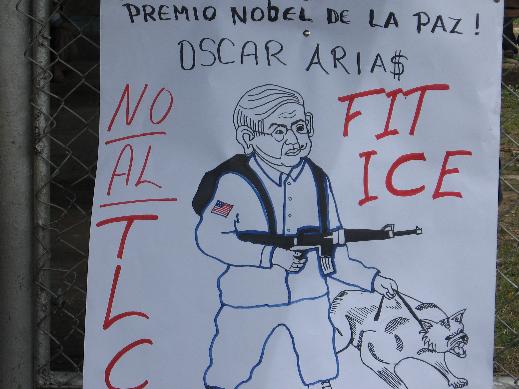
Yesterday we drove down the mountain to the low lands to march in protest against TLC (Tratado Libre Comercial), known in the US as CAFTA (Central American Free Trade Agreement). For the last two days there has been a nation-wide strike of students, farmers, and governmental employees. Costa Rica is the last of the Central American countries and Dominican Republic to ratify the treaty. Ironically, it was the first to push for it.

Julietta, Jenny, Leslie, Brendan, and I all crammed into to Jenny’s little sedan to drive down the bumpy road to Ciudad Neilly and over to Rio Claro where the marchers from Neilly and Golfito were to converge. It was foggy on top of the mountain, but as we dropped below the clouds, we saw the coastal plains open up and caught a glimpse or two of the ocean. Leslie is an intern from Nebraska. She had never been down to the lowlands. As we were driving down the mountain, I started to explain to her the irony of going to a strike against free trade in what used to be a United Fruit Company town. Now the area is all palm-oil plantations; now mostly privately owned by small-scale farmers after La Frutera disbanded.

As we rolled into Neilly, the marchers were gearing up to march to Rio Claro via the Panamericana. We ended up at the front of the line, along with the rice farmers’ union and all their tractors. It was hot. We pushed to the front of the line mostly to get some air flowing. We ended up ahead of the protest waiting with the ICE (Costa Rica’s government-run energy and telecommunications company) for the rice farmers and university students to meet them.


This is what we have learned is at stake in TLC (pronounced TAY EL-AY SAY):

The idea is to create a free-trade zone in Central American and the Dominican Republic.


TELECOMMUNICATIONS
This would lead to the privatization of many governmental agencies such as ICE. Talking to a representative from ICE, he told me that the fear is that the prices would skyrocket as there is would be no governmental subsidies. The “northamerican” idea would be that once the market was “liberated”, competition would lower the prices (maybe not as low as ICE), but to what is a “reasonable” market value. The problem I mentioned to the representative with ICE is that they are backlogged, flooded with work. Many people in our neighborhood have been soliciting phone lines for months. He thinks that free trade is not the answer because the people of Costa Rica are too poor to afford the increase in price.


WEAPONS
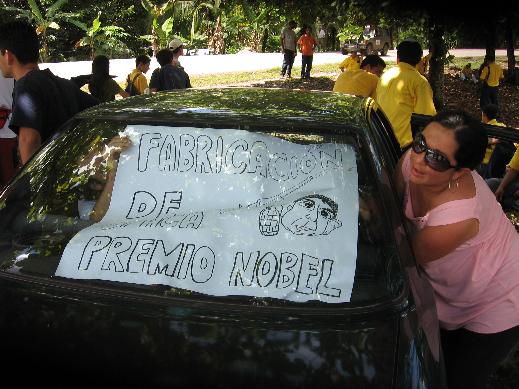
It would bring jobs to Costa Rican including weapons manufacturing plants. Many Costa Ricans feel that this goes against the peaceful culture of a country that abolished its army in 1948. The current president, Oscar Arias, was also president during the 80s and won the Nobel Peace Prize for negotiating between the US-backed Nicaraguan Contra (Counterrevolutionary) army and the socialist Sandanista Party. Oscar Arias (as well as Costa Rica) is considered the diplomat of Central America. Currently he is aiding in negotiations in Colombia between the FLN (Frente de Liberacion Nacional – a U.S.-labeled terrorist organization) and the Colombian government. Many Costa Ricans are now calling him a hypocrite for supporting a treaty that would bring a weapons manufacturing plant to the country.


AGRICULTURE
Another major fear of TLC is the entrance of agricultural corporate giants such as Monsanto. This would increase the price of seeds and fertilizers. It might require local farmers to adhere strictly to Monsanto’s regulations and recommendations. There is also the fear of the introduction of genetically-modified plants and the contamination of the local genetic pool especially in the production of corn. The rice farmers repeatedly said throughout the protest, “Diga no a arroz gringo” (Say no to Gringo Rice).

Costa Rica is the only country in the agreement that hasn’t ratified the treaty. It is almost inevitable that they will within the next few weeks.

Eliot’s Beliefs about TLC

I believe that Free Trade is a beautiful philosophy created a long time ago in a country far away (England I’m pretty sure). Opening free markets does and has helped many people in this world. But the enforcement of it has also brought many wars, genocides, and other horrible atrocities (Vietnam, Guatemala, Chile, Iraq…). With the advances of technology (like the internet especially) free trade is inevitable. For example, you can buy coffee over the internet directly from farmers here in Aguabuena. That is Free Trade in its essence. And currently it verges on illegal, because it is just sliding under the scope of governmental export taxes. In this way opening up free markets DOES help.

BUT, it is hard for a small country to benefit from a free trade agreement with huge countries with trillions of dollars waiting to pour into the country via socially irresponsible corporations such as Monsanto. I don’t say NO to TLC, I say HOW can make it fair, environmentally and socially? This is the task of 21st century. I hope it turns out better than the last one.


The protest ended up blocking the Panamerican Highway.


Jenny put a sign in the back of her car to protest.

Thursday, October 19, 2006

Field Trip #2


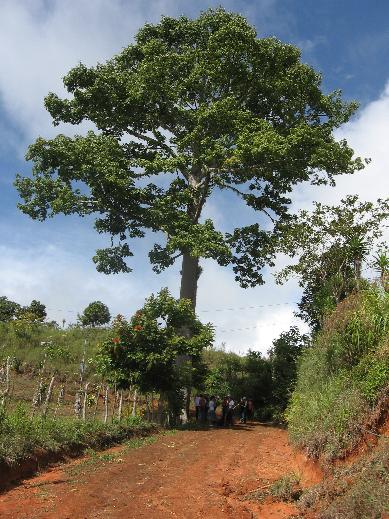
This last weekend we took the Jovenes Ecologicos on a grewling 15 km hike up to the top of Las Brumas mountains to gain a better sense of the region and to pick trash that had been dumped in the forest. We woke up early and hiked up and up. We passed this huge Ceiba tree, as we climbed to the top of the ridge. The weather surprisingly held up, and even though it was foggy on top of the mountain, the clouds cleared for a second so we could see the ocean.

We talked alot about rainforest ecology, teaching the names of trees and how a forest works. We drank from a clean spring on top of the mountain. Many of the kids were surprised that clean water even existed. We picked up trash that had been dumped next to a quarry on top of the mountain. The kids were really into it and took initiative to figure out how to lift the trash out of the steep ditch it was in.
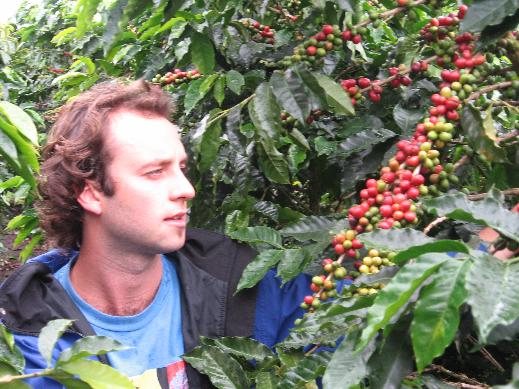
The trip lasted 8 hours, and by the time we got back to Copabuena everyone was ready to fall asleep. The kids are excited for the next field trip. They said they are going to miss us when we go home next week.

Tuesday, October 17, 2006

Harvest Time

The coffee berries are getting ripe, but the Cooperative still doesnt have a functional beneficio. The beneficio is supposed to start processing the coffee next week, but there is still a lot of coffee to be processed in the mean time.
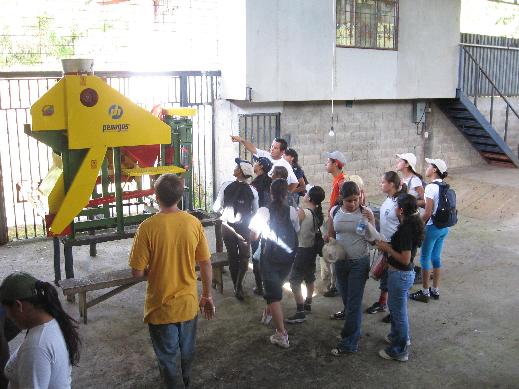
Coffee has to be processed within 24 hours of harvesting. This makes coffee a difficult crop to deal with as it adds a great deal of transportation costs. Every day the ripe beans have to picked and taken to the local beneficio (processing plant). The beneficio washes and removes the skins of the beans so they can be dried and stored for roasting at a later date.

Since the Coopabuena beneficio closed down two years ago, the new cooperative (Coopepueblos) has been without a beneficio, taking the raw berries to be processed by the nearest beneficio in Sabalito (13 km away). This added alot of costs to last years harvest. This year UCSC researchers, Karen Holl and Rebecca Cole, loaned the cooperative $6000 of the $10,000 needed to buy a micro-beneficio. It arrived a few weeks ago, and the cooperative has been hard at work getting it ready for this years harvest. It should be up and running by next week.

Este beneficio es puro columbiano!

Monday, October 16, 2006

Rainy season is here

Up until yesterday, it seemed like the rainy season would never come. This is our first rainy season to spend down here, so we dont know what it is like. It is supposed to start at the beginning of October and last until December, but for the last two weeks it has hardly rained at all (only like every other day). All the farmers we talk to mention how dry it has been. Flor said it has been dry because of El Niño.
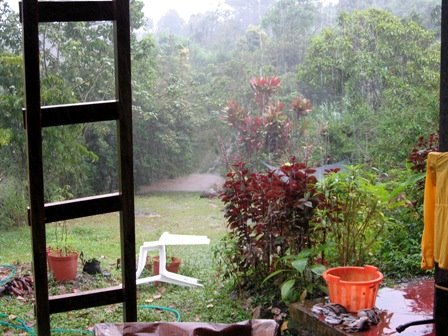
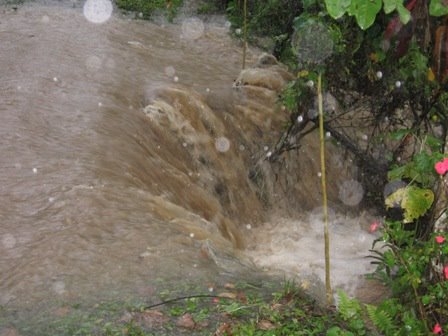
But yesterday it RAINED. The day started beautiful and sunny, but by noon it was sprinkling and by 1 it was pouring. Brendan and I were working on our plan for next year, typing on the computer, shouting over the pounding rain on the tin roof. At one point, we looked out the front door, and the bridge to our farm was flooded. We were stuck on our farm. This was the first flood that had reached over the bridge. We ran outside taking pictures. It was cold. The flood almost got to our seedlings, but they were safe luckily.
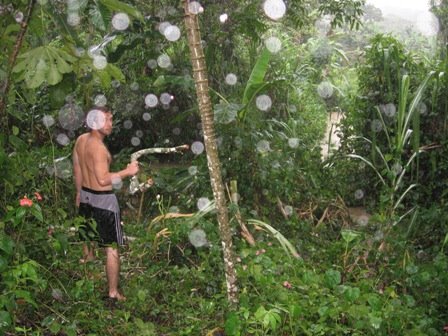
Right now it is raining again and the sky is a very strange orange. I think the rainy season has finally come.

Monday, October 09, 2006

Treking up the Rio Salto

On Friday, Eliot and I met with Jovenes Ecologicos to explore the Cuenca del Rio Salto (River Salto watershed). This ecological youth group was created to introduce youth to environmental issues through local field trips, eco-activities and group discussions. This was our first outing with the high schoolers and it was a great success. We treked 5 kilometers up stream, ending up at the 20 meter waterfall which feeds the river. It was a suprise to me that the majority of the kids had never seen this waterfall, or a monkey for that matter. At the waterfall we had a discussion about the importance of a forested watershed and how it filters and protects the water resource.


We then hiked up above the waterfall to have lunch under a shelter. We talked to the kids in English so they could practice their skills. We talked about this upcoming year, planning for our High School Cultural Exchange Program. They were excited to share experiences like this trip to the waterfall with kids from the US. When we asked them what else they would like to do...they came up with some crazy ideas like tug-of-wars in the mud and karaoke comptetions. I think next year will be a lot of fun.